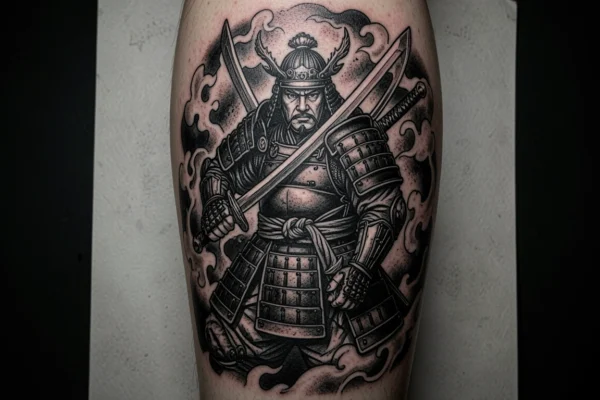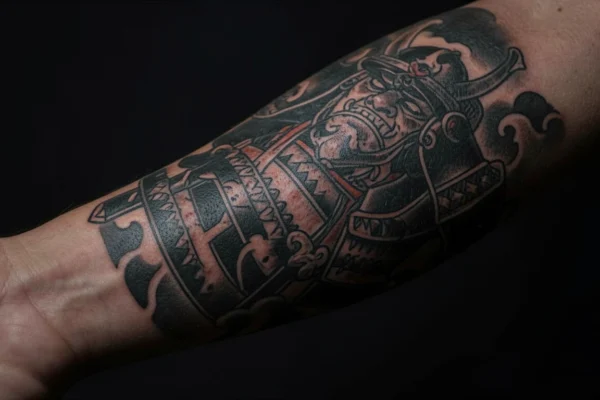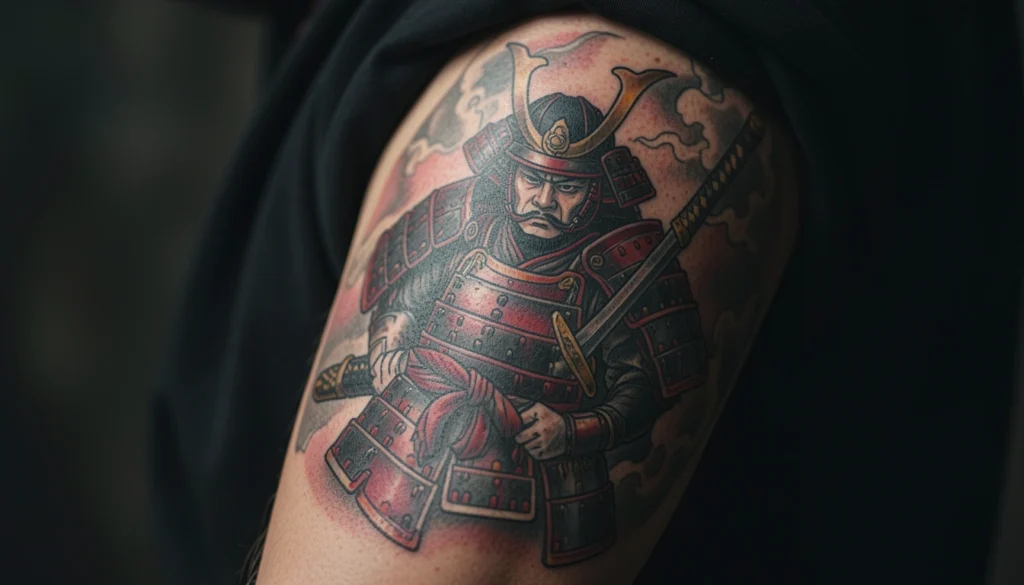
A full thigh piece lets a traditional samurai tattoo design carry armor detail and sweeping background elements, which matters when you want readable linework and a narrative scene. Choosing a pose with two swords or a helmeted portrait changes how much negative space and background motif you need to keep the image clear.
Scale and placement are the next decisions after motif. A vertical composition fits the thigh, calf, or forearm differently than a circular chest or back piece, and a detailed helmet needs more area than a simplified mask, so pick placement with that needs in mind.
The ideas below compare 41 varied samurai approaches so you can see options for pose, ornament, background motifs like waves or flowers, and how to explain those choices to an artist.
41 samurai tattoo examples and traditional samurai tattoo design ideas
Thigh mounted samurai portrait
This thigh samurai shows the benefit of a long vertical canvas that can include torso armor, helmet detail, and a flowing background. On the thigh you can keep smaller elements such as floral accents or script readable by enlarging line weight and spacing. If you like this arrangement ask your artist whether the piece should wrap slightly to follow muscle contours or sit flat on the outer thigh.
Samurai with two swords
A composition with two swords emphasizes action and symmetry and can read well on a forearm or calf when scaled down. Two blades offer the chance to balance ornament on each side such as waves on one and cherry blossoms on the other. Discuss sword angle and hand placement with your artist so the blades do not visually merge at a smaller size.
Warrior amid ocean wave
The samurai framed by a wave creates a classic contrast between rigid armor and flowing water, which helps separate foreground and background. Waves can be rendered in stylized Japanese linework or more realistic shading depending on the overall style you want. If you favor movement, ask for wave rhythm to lead the eye toward the warrior rather than compete with him.
Black and white standing samurai
A black and white depiction places emphasis on line, contrast, and texture rather than color. This works well for smaller placements because it avoids needing color saturation over time, but it does rely on strong line thickness choices and negative space to remain legible. Talk to your artist about using varied needle groupings for texture in armor and cloth.
Archer style figure sketch
A figure holding an arrow is a quieter, narrative choice that can feel less confrontational than a full battle pose. Such a composition invites a softer background and works well on the rib cage or thigh where vertical space supports the figure. Consider whether you want that archer figure to carry a full helmet or a more exposed head to show facial expression.
Skull with samurai helmet
A skull wearing a samurai helmet introduces a memento mori theme and fits the darker motif spectrum within samurai imagery. This approach pairs well with bold black shading and can integrate floral or wave elements to soften the composition. Ask about how much helmet ornamentation you want retained so the piece reads as samurai related and not purely skull focused.
Samurai with lotus foreground
The lotus in front of a warrior mixes martial strength with a symbol of purity and rebirth, which gives the piece a layered meaning. Foreground florals help frame the face and can add color accents without overwhelming armor detail. If you want the lotus to pop, plan for selective color while keeping the samurai itself primarily black and gray.
Two swords by a blossom tree
A samurai posed in front of a tree with pink blossoms uses contrast between solid figure and delicate flowers to create visual depth. Cherry blossoms are often used to soften aggressive imagery and they can be placed to guide the eye toward the face or sword tips. Ask your artist how much blossom detail will stay crisp after healing at the size you want.
Skeleton warrior holding fish
Combining a skeleton with a helmet and a fish is a surreal mix that reads as narrative or symbolic rather than purely historical. When motifs are unconventional like this, clarity depends on distinct silhouettes and contrast between elements. Discuss with the artist how to arrange these elements so the viewer can recognize each motif at a glance.
Hat topped portrait in clouds
A headwear focused study set into clouds keeps the composition intimate and atmospheric, which suits the upper arm or chest. Cloud backgrounds can be soft shaded or stylized line work to match the samurai rendering. If you prefer mood over maximum historical detail, this approach concentrates on expression and silhouette.
Old school Japanese motif
Old school Japanese style blends bold outlines with simplified shading and often limited color palettes, which helps the tattoo age predictably. This approach can be a good fit if you want a graphic, iconic samurai rather than a photoreal portrait. Confirm whether you want modern linework techniques or classic strong outlines to achieve that look.
Ornate helmet portrait
An ornate helmet allows for decorative engraving and texture that read well as a focal point in a chest or upper arm piece. Fine details on the helmet require enough scale to avoid blurring over time, so plan size accordingly. Ask the artist which areas will need heavier outlines to retain the ornate feel through healing and years of wear.
Demon face with floral crown
A Japanese demon with flowers over the face mixes the eerie and the delicate which can produce a memorable center piece. Mixing a mask like this with floral accents works well for a back or large chest piece where negative space gives breathing room. If you want the demon toned down, consider placing blossoms to obscure some facial features while leaving the helmet visible.
Mask and red sun backdrop
A samurai mask over a red sun and a splattered background creates a high contrast, dramatic piece that reads strongly from a distance. Using a single bright color like red can anchor the composition and emphasize the mask. Talk about pigment placement and longevity with your artist, since vivid red requires planning for touch ups down the road.
Mixed motifs on white background
A sheet of multiple small samurai related designs on white space is useful when you want a portfolio of ideas to combine later. This format is ideal for selecting elements that work together in scale and line weight before committing to a larger composition. Use these as study pieces to pick the motifs you want repeated or enlarged for a final tattoo.
Pagoda scene with umbrella
A figure with an umbrella in front of a pagoda creates strong architectural balance and a storytelling moment. This arrangement suits broader canvases like the upper back where both the building and the figure can be portrayed at scale. Confirm with your artist how much architectural detail you want so the pagoda does not become an indistinct backdrop.
Dynamic ink warrior study
An ink drawing style emphasizes brush stroke energy and can lend a spontaneous feel to a samurai image. This works particularly well when you want an illustrative look that does not aim for photorealism. Ask whether the artist will translate brush like strokes into tattoo linework or prefer a more controlled ink wash effect with stippling and gray shading.
Red ink sketch on paper
A design rendered in red ink on paper can be a study for future color accents, and it shows how selective color can highlight armor details or blood motifs. When converting that look to skin, discuss color saturation, contrast against skin tone, and where red will age differently than black ink. Consider using red sparingly to prevent early fading into duller hues.
Mask and floral surround
A samurai mask held by hands and encircled by flowers creates a ceremonial feeling and makes an effective chest or upper back centerpiece. Placing flowers around the mask frames the focal point and offers room for color without distracting from the face. Decide whether the hands will show gloves, armor, or bare skin to adjust the story the piece tells.
Mechanic style portrait with helmet
A man holding a wrench while wearing a helmet blends everyday tools with warrior imagery in a contemporary twist. If you like hybrid themes, consider how modern props will sit with traditional armor lines to avoid visual conflict. Ask the artist to test compositions that keep the wrench silhouette distinct from sword shapes for clarity.
Skull with helmet and flowers
Adding flowers to a skull in a helmet adds a softer counterpoint to macabre imagery and improves compositional balance. Floral elements can also introduce color focal points while the skull and helmet remain monochrome. When selecting flowers, pick types and placements that support the visual flow around the helmet rather than crowding its ornamentation.
Full armor, two swords shoulder
A fully armored samurai with two swords on the shoulders is a classic full figure composition that benefits from a taller canvas such as the back or thigh. Armor detail requires consistent light source decisions so textures and plates read as three dimensional. Confirm whether you want the piece to be highly detailed or simplified in areas where the body moves to preserve line integrity.
Skeleton with brimmed hat
A skeleton wearing a hat leans into a stylized, illustrative realm and can make a strong smaller scale piece on a forearm or calf. Because skulls and hats share similar color values when inked in black and gray, outline contrast and negative space become important. Discuss which elements get heavy outlines so the hat remains a readable shape after healing.
Portrait of armored man
A black and white portrait in armor prioritizes facial expression and ornate protection details and is well suited for a chest placement where symmetry can be centered. Portraits need clear reference images so the artist can capture features and lighting. Bring multiple reference angles and decide whether you want stylized shading or a realistic approach.
Umbrella figure by pagoda
A figure with an umbrella creates a cinematic scene where negative space is as important as the subject. Pagoda architecture adds directional lines that can balance figure placement on broader canvases. If you like scene building, discuss how much background detail you want versus a simpler silhouette focus.
Knife and flowers on arm
An arm piece mixing a blade and flowers juxtaposes aggression and softness and can be arranged as a vertical sleeve accent. For forearm work, ensure the blade direction aligns with arm motion so the composition reads when the arm is at rest. Ask whether thin floral lines will hold up or should be reinforced with heavier detail for longevity.
Photo reference arm tattoo
A real arm photo of an existing tattoo helps set expectations for scale and how the piece sits on muscle. Use such references to discuss wrapping, stretching, and how the design will look when you bend the elbow. Your artist can mock the placement with temporary stencils so you can test visibility across positions.
Red hat portrait with knife
A subject wearing a colored hat holding a knife shows how a single color can anchor a composition and draw attention. If you plan to use red as a focal color, verify how it will contrast with skin tone and surrounding black ink. Consider whether other small color accents might support the red without competing for visual dominance.
Back piece study with multiple images
A back layout that contains several related tattoos allows a larger narrative or a collage of motifs to breathe. For back work, place the strongest element near the spine or center and let supporting motifs cascade outward. Plan negative space intentionally so the overall installation does not feel crowded.
Samurai afloat among blossoms
A figure standing on water with cherry blossoms around him gives a serene yet dramatic impression and suits a medium to large canvas. The reflection or water line can be used to ground the figure and prevent the image from appearing to float aimlessly. Decide whether you want the water stylized or realistic to match the rest of the piece.
Sword and helmet study
A simple study of a samurai holding a helmet and sword offers a quiet, ritualistic mood and works well for chest or thigh placement. This type of pose invites careful attention to hand anatomy and helmet ornamentation. Talk with the artist about the balance between face detail and helmet shine so one does not overpower the other.
Arm photo showing existing ink
Using a photo of someone with a samurai arm tattoo helps you evaluate how a design sits and ages on actual skin. Study line crispness and how shading softened over time to set realistic expectations. Bring such photos to your consultation and ask the artist what techniques they use to prolong edge sharpness.
Geisha and full moon
Pairing a geisha with a full moon and flowers makes a moody scene and can complement a samurai by adding narrative context. This type of artwork often reads as a pair or a larger sleeve concept where characters interact across panels. If you plan a themed sleeve, map out how each figure will flow into the next and which motifs will bridge them.
Leg black and white study
A black and white leg tattoo focuses on contour and form and can be scaled to fit the length of the calf or shin. For leg work, consider how the design will look both standing and seated, and whether muscle movement will distort key details. Ask the artist about line flow that follows the leg rather than fighting its natural shapes.
Evil faced warrior crest
An aggressive, evil faced samurai with crowns or crests reads as an emblem and suits a shielded chest location or upper arm. Emphasize strong silhouette edges and controlled shadow to keep the crest from blending into surrounding skin. Discuss whether you want softer gray shading or stark black for a more emblematic look.
Standalone mask in black and white
A mask alone is a bold, graphic choice that works at many sizes and placements and can be integrated into larger pieces later. Because masks are symbol heavy, decide if you want facial markings preserved or simplified. Bring several reference angles to your artist so they can ensure helmet proportions look correct on your body.
Samurai with dragon and clouds
Including a dragon and clouds ups the scale and mythic feel while offering a dynamic background that can frame the samurai. Large mythic animals require spacing to avoid visual clutter, so allow your artist room to separate dragon scales from armor plates. Consider using cloud bands to lead the eye across the canvas rather than packing every area with detail.
Stomach piece featuring figure
Stomach placement introduces movement from breathing and weight shifts, so ensure line choices accommodate that change while still reading well. A central figure here can anchor the torso if it is composed symmetrically, or you can offset it to work with surrounding tattoos. Ask your artist to preview the stencil while you move to see how distortion occurs.
Floral crowned samurai portrait
A portrait with flowers on the head softens martial undertones and provides opportunities for color points in an otherwise monochrome composition. Floral crowns can also mask transitions to other tattoos if you plan a broader sleeve or chest piece. Decide whether flowers will be colored or rendered in black and gray for a consistent palette.
Seated samurai study
A samurai sitting on the ground portrays rest or meditation and makes a contemplative piece that suits a smaller canvas like the forearm or thigh. Seated poses allow for more visible armor detail in a compact vertical form. Work with your artist to ensure the pose reads when the limb bends, for instance when the arm is flexed or the leg is seated.
Chest centered portrait
A chest portrait places the samurai at the heart of the body and can be mirrored with shoulder ornaments for symmetry. Chest work benefits from clear focal points and simplified edges near the sternum so breath and movement do not distort key features. Talk to your artist about transitions toward the shoulders if you envision future expansion into a full torso piece.
Planning and technical considerations for samurai tattoos
Traditional samurai tattoo design requires balancing figure detail, background motifs, and the physical surface of the body. Armor plates, helmet ornamentation, and facial expression demand careful line weight decisions so tiny features do not blur over time. Before booking, decide which elements are essential and which can be simplified; bring clear reference images and ask the artist to mark the stencil on your body so you can view the composition in motion.
Placement affects readability and healing. Muscular or high friction areas such as the inner thigh or lower rib cage may distort or require touch ups, while flatter areas like the outer thigh or upper back usually preserve detail longer. Discuss pigment choice too: selective color can accentuate flowers or suns, but black and gray often ages more predictably. Finally, budget time for multiple sessions for larger pieces and request an aftercare plan tailored to the amount of shading and color in your final design.
Frequently Asked Questions
A thigh placement can support a large, vertically oriented samurai design that includes helmet detail and background motifs. Because armor and facial elements benefit from scale for legibility, aim for a design that is at least medium to large in size rather than a small icon. Discuss with your artist how the samurai will wrap around the thigh and where to position focal points so they remain visible when you stand, sit, and move. The artist can create a stencil so you can preview how muscle shape and movement will affect the composition.
Yes, a traditional samurai tattoo design can be successful in black and gray and this approach emphasizes line work, texture, and contrast rather than color. Black and gray often ages more predictably than saturated color because it relies on strong outlines, graduated shading, and contrast to preserve detail. If you favor black and gray, request varied needle groupings for texture in armor plates and cloth and discuss where heavier outlines will preserve definition, especially in areas with fine ornamentation or where the skin stretches.
Combining a samurai with lotus or cherry blossoms creates contrast between martial strength and delicate natural elements and is a common compositional strategy. Use flowers to frame the face, soften helmet edges, or guide the eye across the design; placing blossoms in the foreground adds depth and can introduce selective color without overwhelming armor detail. During consultation, specify whether flowers will be rendered in full color or black and gray and ask the artist how much detail will remain crisp at the chosen size so petals do not blur as the tattoo heals.
Ask the artist what size and placement they recommend for preserving armor and facial details and whether any elements need simplification to remain readable. Inquire about line weight strategy, needle groupings for texture, and whether they suggest selective color versus black and gray for your skin tone. Also ask for a preview stencil and how many sessions they expect to complete the piece, and discuss aftercare and touch up policies since detailed work can need maintenance to keep the fine lines crisp over time.
Using samurai imagery can be meaningful for many people, but it is important to approach cultural symbols with respect and awareness of their historical context. Instead of treating the motif as purely aesthetic, learn what specific elements represent and choose motifs that align with thoughtful intention; consult reputable sources or ask your artist to explain symbolism. If cultural sensitivity matters to you, consider collaborating with an artist who understands Japanese artistic conventions and who can guide you in creating a design that honors the subject rather than appropriating it superficially.
A forearm or calf offers a moderate canvas that can handle medium levels of detail but requires prioritization of the most important features. Faces, helmet ornamentation, and sword edges should be slightly enlarged compared to a large back piece so the lines do not compact and blur. Work with your artist to simplify background textures and use thicker outlines for critical silhouettes while retaining fine internal shading where it will still read clearly after healing and during normal wear.
Plan for multiple sessions for a detailed samurai piece, separating line work, shading, and color into stages so skin can rest and heal between sittings. Follow the artist recommended aftercare routine closely, which usually includes gentle cleaning, applying a thin protective ointment or moisturizer, and avoiding prolonged soaking or heavy friction on the area during initial healing. Because detailed shading and color may need touch ups down the line, discuss follow up visits and realistic timelines for settling, and ask your artist how they handle fade management to maintain the integrity of fine elements like helmet engraving and facial features.
Choosing a traditional samurai tattoo design becomes easier when you narrow options to pose, level of ornament, and background motif. Save a small selection of favorites that highlight those differences and note whether the appeal is the helmet detail, the two swords, the floral framing, or the mood created by waves and clouds. Bring those references to a consultation and ask your artist for a stencil preview so you can confirm placement and scale before the first session; that process gives you a clear direction to move forward with confidence.