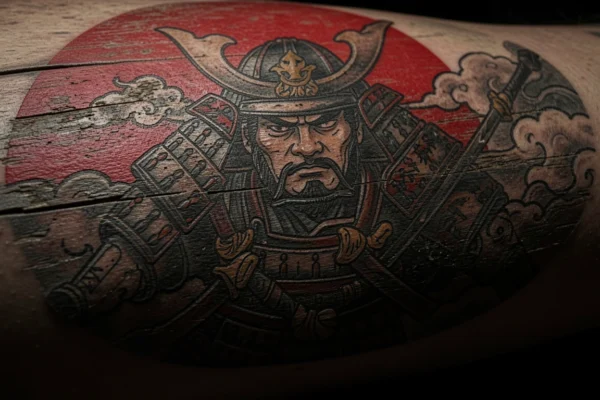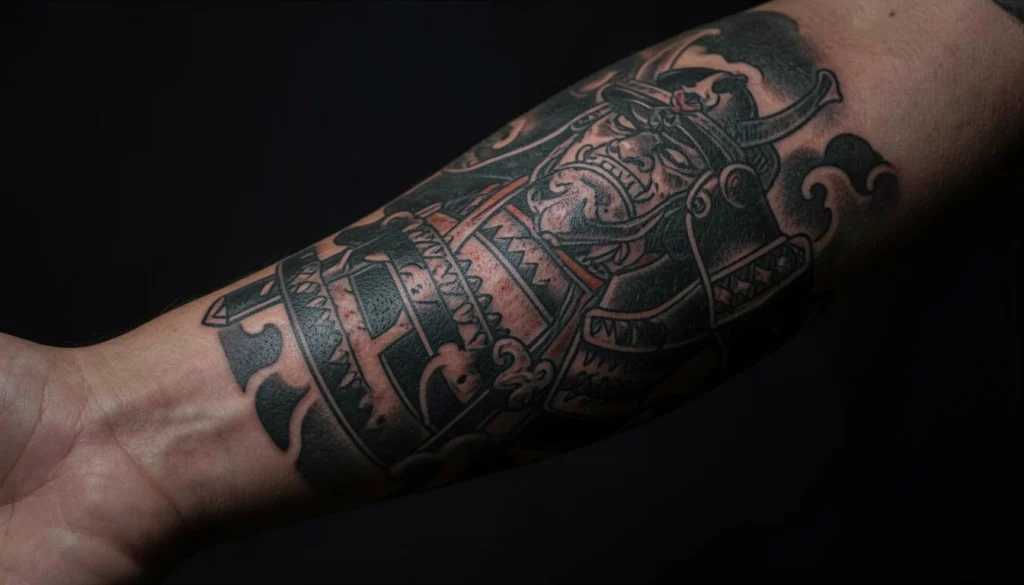
A compact silhouette and heavy fill define how a blackwork samurai tattoo design will read at a glance, so the balance between solid black areas and empty skin matters for clarity. Choosing bold shapes over fine texture keeps the samurai figure distinct as it moves with the body. The primary keyword describes a style where contrast and form are the message rather than color or delicate shading.
Scale and placement change what details you can show. A full back or chest piece lets an artist include armor patterns, background architecture, or a pagoda, while an arm or calf works best with a single strong pose or mask. Consider where the curved planes of your body will stretch the design and whether you want the samurai to face inward or outward.
The ideas below help you compare line treatment, iconography, and compositional choices so you can pick a direction to take to an artist. Each pin commentary highlights one clear decision to make when planning a blackwork samurai tattoo design.
27 blackwork samurai tattoo design ideas to compare
Armored samurai with dual swords
This drawing focuses on a fully armored warrior holding two swords which emphasizes a classical stance and presence. For a blackwork version, the armor plates become areas of solid black separated by thin lines of skin to suggest joints and texture. Ask your artist how much outline they will keep versus how much they will simplify into geometric black masses, since armor detail can become muddled at small sizes.
Standing samurai in silhouette
This pin presents a samurai holding two swords in a straight posture which lends itself to a silhouette interpretation. In blackwork you can make the figure read as a strong single shape and reserve negative space for sword edges and facial masks. This approach works well for forearm, upper arm, or rib placements where a tall compact vertical composition will fit without wrapping awkwardly.
Kneeling warrior ink study
A samurai on his knees suggests humility or a moment of ritual which is powerful in portrait size. For blackwork, leave thin areas of skin to trace the folds of robes and the curve of the helmet while filling the shadows with rich black. Consider a background element such as a crescent moon or a small wave motif to anchor the figure and prevent the silhouette from feeling isolated on larger canvases.
Gas mask juxtaposition
A black and white photograph of a man with a gas mask introduces modern urban elements that can be combined with samurai imagery for a hybrid design. If you like that contrast, ask the artist to integrate traditional samurai armor lines with angular mask shapes so the two visually belong together in a single blackwork composition. Be mindful that facial detail will need simplification, so focus on strong contours and symbolic elements rather than tiny features.
Skull samurai with swords
A skull wearing a hat and holding swords blends mortality symbolism with warrior iconography and translates well to blackwork because bone and negative space contrast sharply. Decide whether you want decorative elements like hat trim or flowers in skin color or rendered as black shapes to keep visual hierarchy clear. For chest or back placements this motif can be expanded with banners, rope, or kanji rendered as clean black strokes.
Back piece with figurative imagery
The referenced image of a tattooed back implies a large canvas where a samurai figure can be combined with landscape elements. Blackwork excels on large surfaces because the bold fills age well and maintain contrast across time. If you plan a back piece, discuss how the composition will sit between the shoulder blades and lower back so the main figure remains readable when you move or bend.
Arm study with weapon focus
An arm design showing a man with a black and grey tattoo holding a knife draws attention to weapon detail which can be translated into blackwork by simplifying blade reflections to strips of skin. For forearm placement consider vertical alignment so the sword or knife runs with the limb. Keep in mind that busy small details near joints may blur over time so emphasize bold edge shapes.
Stomach samurai with compact pose
A samurai on the stomach holding two swords suggests a compact central motif that could be framed by surrounding flora or waves. Blackwork will read clearly across the flat plane of the torso, but you should plan a strong centerline so the composition does not distort when you sit. Ask whether the artist will use skin breaks to indicate armor detail or rely on line work inside the black fields.
Demonic mask with floral accents
An illustration of a horned demon with flowers pairs aggression with ornament which is a common motif in Japanese inspired work. For blackwork, the demon becomes a heavy silhouette while flowers can be rendered as outlines or inverted negative space to create contrast. Think about whether you want the demon to dominate the composition or serve as a background antagonist behind the samurai figure.
Leg placement with demon imagery
A tattoo on the leg that incorporates a demon offers a tall, narrow canvas perfect for a vertical samurai scene. Blackwork here benefits from elongated shapes and repeated patterns that move with the calf or thigh. If you plan full leg coverage, coordinate how the samurai and demon balance across the curve so one does not visually overpower the other when viewed from the side.
Skeleton with floral composition
A skeleton with flowers places life and death imagery side by side which can support a samurai theme about honor and mortality. In blackwork, skull and bone shapes translate to strong negative space and solid black shadows, while flowers can be simplified to line or partial fill. Consider adding a katana or helmet to tie the skeleton to the samurai narrative without crowding the composition.
Portrait with headpiece and ornaments
A face surrounded by flowers and butterflies implies a softer portrait that can pair with samurai themes for contrast. For blackwork adapt delicate elements by rendering petals as silhouettes or open shapes to maintain legibility. If you want facial expression included, plan for a larger piece because subtle expression requires more surface area to avoid becoming a blot of black.
Samurai before a burning pagoda
A samurai standing in front of a pagoda with flames provides a dramatic narrative that plays well in blackwork through layered silhouettes. Flames can be suggested by curved negative space within black fields to give the illusion of light without gray shading. For back or chest placement this keeps the scene bold and readable even at a distance.
Flaming chest motif
A samurai with flames emerging from the chest centers symbolic energy in the torso which fits blackwork because the contrast emphasizes the core. Decide if you want the flames stylized or realistic; stylized shapes are more consistent with blackwork and scale better. In a chest piece, use symmetry carefully so the central figure does not look off balance when you breathe or move.
Demon holding modern object
An evil demon holding a baseball bat introduces modern props into traditional imagery which may appeal if you want a contemporary twist. For blackwork, render the bat as a bold linear object and let the demon remain a dense mass with selective skin breaks for teeth and eyes. Clarify with your artist how the composition will age where fine teeth lines might blur with time.
Minimalist samurai sketch
An ink drawing of a samurai holding two swords that reads like a sketch can be adapted into a blackwork piece by converting ink strokes into thicker black strokes and larger fills. This keeps the gesture and energy of the original while ensuring longevity in tattoo form. For small placements ask for a mockup showing how the sketch lines will be converted so you know which marks will remain.
Abstract snake and hook
A snake wrapped around a tube with a hook is an abstract element that can frame a samurai or serve as border detail in blackwork. Use bold snakescale patterns as black textures to contrast the flat areas of a samurai silhouette. When combining motifs, keep the main figure central and simplify surrounding elements to avoid visual competition.
Classic samurai ink study
An ink drawing of a samurai in black and white highlights pose and gesture which are ideal starting points for blackwork adaptation. Focus on which lines define the pose and which are decorative because the latter will likely be removed or thickened. For a sleeve consider repeating the samurai motif in smaller panels separated by black bands or floral negative space.
Knife with flames and ritual tone
A woman holding a knife with flames suggests ritual and narrative that can support a samurai figure as an ally or opponent in a larger scene. In blackwork, knives read clearly when the blade is defined by negative skin lines and the handle by solid black mass. If you want this next to a samurai, ensure each element has room so the eye can separate the weapon from the primary figure at a glance.
Skeleton with blade and shadow
A skeleton holding a knife creates a stark, symbolic motif where bone and weapon become the focal points in blackwork. This motif pairs naturally with samurai themes about honor beyond death and can be combined in a single composition if spaced carefully. Ask the artist to show a contrast study so bone shapes are not lost against a heavily filled background.
Artistic arm composition
An artistic arm design suggests flowing composition that follows musculature and wrap. Blackwork samurai designs on the arm can emphasize motion by angling the figure and using black bands or waves to guide the eye. Make sure the main focal point sits where viewers will naturally look when your arm is relaxed rather than twisted.
Decorative knife blade study
A detailed drawing of a knife with an elaborate blade invites ornamental elements that can border a samurai or be folded into armor decoration. In blackwork convert fine blade engraving into areas of pattern or repeated marks that read as texture rather than tiny lines. When used alongside a samurai, keep ornamental density lower near the face or helmet so the figure remains prominent.
Traditional samurai portrait
A classic black and white drawing of a samurai gives you a baseline for a faithful silhouette style. Portrait oriented samurai pieces benefit from a clear helmet and shoulder line and minimal midtone shading if you want strict blackwork. Discuss whether hair, cloth folds, or facial features should be represented by negative space or retained as thin ink lines for expression.
Bird, tree, and cross scene
A bird flying over a tree with a cross implies allegory and landscape that can become atmospheric background for a samurai. For blackwork try layering silhouettes with varying densities so the samurai remains in the foreground, the tree midground, and the bird a small focal accent. Consider scale so that the background elements do not overtake the primary figure in a crowded design.
Weapon grip and arm pose
A tattoo of a man holding a knife and an arrow suggests active motion and a clear hand pose which is useful for samurai compositions showing readiness. In blackwork the hand can be simplified to block shapes to preserve the gesture without small joints and tendons that may blur. Place such a motif on an area with enough skin to show hand orientation clearly, usually the forearm or thigh.
Warrior with floral chest detail
A Japanese warrior with flowers on his chest balances martial strength and softness which can enrich a samurai concept when translated to blackwork. Flowers can be shown as white space set against black armor to prevent the piece from becoming visually heavy. If the warrior has glowing eyes or other small luminous details in the reference, ask how those will be suggested using skin breaks rather than color.
Samurai mask with floral frame
A samurai mask surrounded by flowers is a classic motif that works well in blackwork by contrasting solid mask shapes with delicate floral outlines. For a cohesive composition decide whether flowers are purely decorative or carry symbolic meaning to you, then keep their rendering consistent with the rest of the piece. Masks make strong focal points on shoulders, upper arms, or the chest where they can be centered and framed.
How to customize a blackwork samurai tattoo with an artist
Start by choosing the right scale and placement because blackwork depends on large, confident shapes that read from a distance. If you want intricate armor patterns, plan for a larger canvas such as the back, chest, or full sleeve so the artist can preserve detail without creating tiny hairlines that will spread. Conversely, if you prefer a compact piece for an arm or calf, ask the artist to simplify textures into block shapes and to show you a stencil mockup so you can see how the silhouette flows with your anatomy.
Next, clarify iconography and narrative because the samurai motif can carry different meanings and visual pairings, from skulls and demons to pagodas and floral motifs. Decide what should be dominant visually and what should be supportive so elements do not compete. Finally, discuss technique and aftercare expectations specific to heavy black fill; solid black areas require careful layering and touchup planning, so ask your artist about session timing and what to expect during healing for consistent results.
Frequently Asked Questions
The best size depends on how much detail you want and where you plan to place the tattoo. For readable armor patterns, facial expression, or layered background elements choose a larger canvas such as the chest, back, or a full sleeve so the artist can preserve shapes without reducing them to fine lines. For smaller placements like the forearm, calf, or rib area, simplify the design into bold silhouettes and avoid very thin decorative lines that are likely to blur as they age. Ask your artist for a stencil mockup at the intended size so you can judge whether the composition still reads clearly when placed on your specific body area.
Placement should follow both the visual flow of the design and how your body moves because blackwork relies on solid shapes that must remain legible when you bend or turn. Large, relatively flat areas like the back, chest, and thigh are ideal for full narrative scenes with background architecture or multiple figures. Narrower areas such as the forearm, calves, and ribs work well for single poses or vertical compositions where the silhouette can run with the limb. Consider whether you want the samurai to face inward toward your body or outward to the world and ask your artist to adjust the orientation so the figure reads naturally from common viewing angles.
Yes, a detailed reference can be converted into effective blackwork but it requires careful simplification rather than literal copying. The artist will identify the most important lines that define pose and character and convert secondary textures into larger black or negative shapes that suggest detail without tiny strokes. For example, ornate armor can become patterns of alternating solid black and skin lines instead of intricate etching. Request to see variations from the artist showing a more literal version and a simplified blackwork version so you can compare how much character is preserved and how the design will age on skin.
Common motifs that complement a samurai include pagodas, waves, chrysanthemum or peony flowers, masks, skulls, and stylized demons because each offers a clear silhouette that works within blackwork. Symbolic choices influence the narrative so pick elements that support the meaning you want, whether that is honor, mortality, struggle, or protection. When combining motifs maintain a visual hierarchy by keeping the samurai as the focal point and rendering secondary motifs with simpler shapes or less visual density so the composition remains balanced and legible from a distance.
Blackwork often uses large areas of solid pigment which can scab differently than fine line work and require attentive aftercare to ensure even healing. Follow your artist’s cleaning and moisturizing routine and avoid picking at any raised scabs because that can leave patchy areas in a field of black. Over time black fills may require touchups to retain saturation and crisp edges depending on your skin type and sun exposure, so discuss realistic maintenance expectations and potential session timing with the artist before you begin. Protecting the tattoo from prolonged sun exposure also helps preserve a uniform appearance.
Ask the artist about their experience with large black fields and with translating detailed references into bold, readable shapes because technique matters for longevity. Request to see healed examples that match the scale and style you want, and ask how they will handle small details that might blur over time. Also inquire about session estimates, how many sessions the work will require, and whether they recommend leaving certain areas as negative space for contrast. Finally, ask for a stencil preview placed on your body so you can assess composition, orientation, and how the design interacts with your anatomy prior to inking.
Choose a mask portrait if you want a compact, powerful focal piece that fits well on the chest, shoulder, or upper arm and reads clearly at moderate sizes. A full figure is better for narrative and movement and requires a larger canvas such as the back, thigh, or full sleeve to show posture, clothing, and background elements without overcrowding. Consider whether you prefer symbolic simplicity or a scene that tells a story, then ask the artist to show how each option will look at the intended scale so you can compare readability and impact on your specific placement.
Choosing a blackwork samurai tattoo design comes down to three practical decisions: scale, iconography, and how elements will be simplified into bold shapes. Narrow your options by selecting two to three references that show the pose, motifs, and level of detail you prefer then note what you like about each one. When you consult an artist bring those references and ask for a stencil at the intended size so you can confirm orientation and balance; that step brings abstract ideas into a clear plan ready for inking.