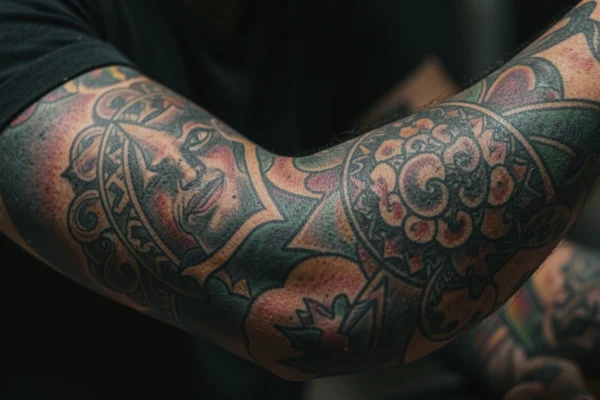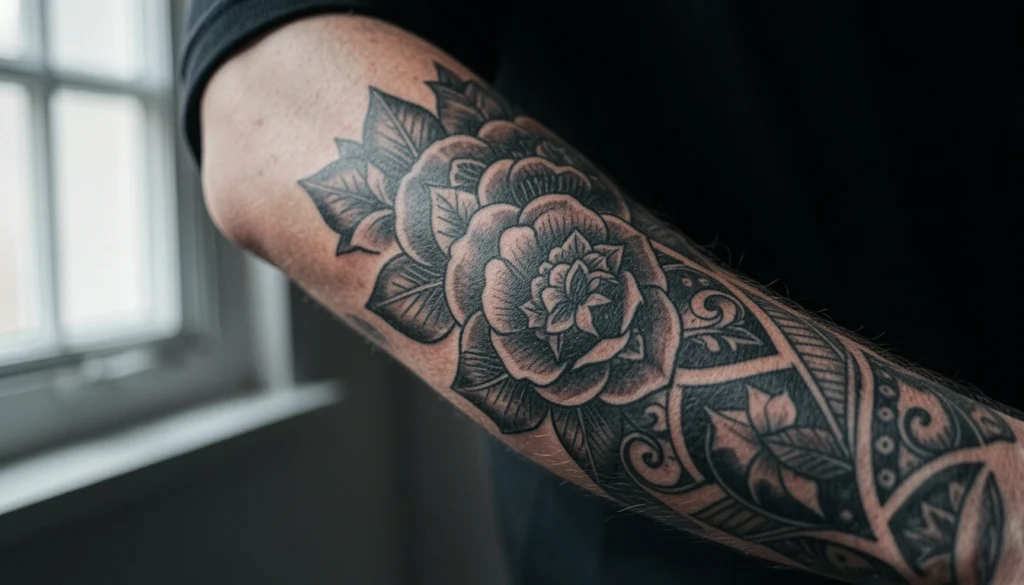
Solid black fill and careful use of negative space are core to choosing blackwork sleeve tattoos for guys because those choices determine how motifs read from across a room and how the sleeve flows with arm anatomy. The amount of black ink and the spacing between elements affect visual weight and long term readability.
Scale and motif type are the next decisions most clients face. A geometric pattern, realistic portrait, or repeating icon each needs different line thickness and spacing so the design stays coherent as the skin ages and the piece is expanded.
The gallery below collects distinct directions within blackwork sleeves so you can compare composition, motif, and contrast. Use the notes after each pin to decide what to save to show your artist at a consult.
20 blackwork sleeve tattoo ideas for guys
Compact upper arm statement
The photo suggests a single focused piece on the arm that relies on silhouette more than tiny detail. For a blackwork sleeve this approach works well if you want a bold anchor near the shoulder or bicep that carries weight without needing micro shading. Ask your artist to plan surrounding elements so the anchor connects and does not look isolated if you later extend the sleeve.
Dense full sleeve coverage
A full sleeve that leans into blackwork usually balances packed areas of solid black with lighter panels of dot work or line detail to preserve contrast. When the sleeve is dense from wrist to shoulder, transitions between motifs matter more than individual images. In a consult bring photos of how other sleeves wrap the elbow and inner arm so your artist can map flow and session stages.
Organic branch and negative space
The tree branch motif in the description points to organic blackwork that uses sinewy lines and empty pockets to suggest light. With natural subjects you can keep the heavy black but preserve breathing room around limbs so the branch does not become a blotch. Discuss edge treatment with your artist so the branch looks intentional when the arm moves.
Geometric panels with hexagons
Hexagon and tessellation elements make a blackwork sleeve read as pattern rather than imagery, which can be useful when you want a modern, graphic look. Those repeating shapes should align with muscle flow to avoid distortion around joints. Ask for a mockup to see how rows sit across the forearm and whether you prefer crisp outlines or softer shaded edges.
Street style arm placement
A sleeve that shows bold motifs on the hand and forearm needs careful planning because skin on the hand and fingers shifts more with movement. If you want continuity from hand to upper arm, prioritize strong line weight and thicker blacks near the wrist so the piece keeps contrast as it heals. Clarify with your artist whether to include the hand now or save it for a later session.
Portrait leaning black and grey
When a sleeve incorporates portrait style elements within blackwork, the key is to decide how much realism you want versus stylized silhouette. Heavy black surrounding a face can frame it but may overwhelm subtle facial shading. Talk to the artist about reference photos and which areas should stay graphic and which can be shaded with gray wash to preserve facial clarity.
Illustrative black and white head
An illustrated head rendered in black and white works well as a focal panel on the upper arm or inner forearm. The illustrated style allows the artist to use line weight to suggest depth without relying on soft shading. Consider whether you want that panel to stand alone or to be connected with background texture so it reads as part of a sleeve rather than a patch.
High contrast sleeve coverage
When an arm is covered mostly in black and white ink the visual language becomes one of mass and pause points. Use bands of negative space or patterned breaks to prevent the sleeve from appearing visually heavy in one area. If you plan for future additions share how dark you want the final look so new sections will match existing density.
Chest and arm continuity
Connecting chest pieces to a blackwork sleeve calls for a composition that flows across the shoulder and clavicle. The chest canvas is flatter so motifs can be larger and airier, while the arm needs wrapping details. Bring photos of how clothes sit when you move so the artist can avoid placing important elements where fabric will hide them most of the time.
Figurative woman sketch style
A drawn woman motif translated into blackwork can be very graphic, especially when outlines are emphasized over shading. Decide if you want the figure to be a central portrait or part of a larger tapestry of images. When combining figurative work with ornament, plan borders and connectors so each element has breathing space.
Landscape with clouds and mountains
Landscape sleeves use bands to suggest horizon, sky, and ground which fits the column of the arm well. For blackwork translates choose whether the sky will be negative space or filled with dot work to suggest atmosphere. Ask for a schematic that marks where the elbow fold will intersect the horizon line to avoid losing detail there.
Gesture and motion in the arm
Pieces that emphasize gesture often use flowing black shapes to follow muscle direction and accent motion. For sleeves that include raised black areas, ask about how they will sit with the inner arm which creases more. Consider session ordering so complex movement lines are placed when skin is fresh and the artist can keep edges crisp.
Symbolic cross motif
Religious symbols like a cross can function as a bold focal point within a blackwork sleeve, particularly when contrasted with open space or patterned borders. Think about scale so the symbol remains recognizable at a distance and does not get lost among heavy textures. If personal meaning matters, bring reference material and discuss subtle additions that reinforce the story.
Sophisticated black and grey portrait
Combining gray wash with blackwork requires an artist comfortable with both solid fills and smooth grayscale transitions. Gray areas can give a portrait dimension while surrounding blacks frame it for impact. When you want portrait realism within a predominantly blackwork sleeve, ask the artist for healed photos of similar blended pieces.
Floral panels and open skin
Flowers translated into blackwork can be graphic or delicate depending on line weight and filling. Use white or clear skin as a design element between blooms to give the eye places to rest. If you plan several floral panels, vary sizes and orientations so the sleeve reads as layered rather than repetitive.
Mythic woman and dragon composition
A combination of a figure and a dragon in blackwork reads as narrative when positioned to lead the eye up the arm. Decide whether the dragon should wrap in a spiral or sit as a backdrop behind the figure, since each choice affects movement and spacing. Request a layout mockup so the relationship between the two elements is clear before inking.
Bold single panel portrait
A single bold panel placed on the outer arm can become the anchor for a sleeve expansion later. If the panel has heavy black around it, plan how neighboring patterns will be added so they do not compete for attention. Bring photos of other single panel pieces you like to show preferred margins and spacing.
High coverage forearm focus
When the forearm is heavily inked, contrast between wrist and elbow areas helps maintain legibility. Consider a band or patterned break near the wrist to prevent everything from blending into one mass. Ask the artist how the piece will look under different lighting so you know which textures will remain visible in daily life.
Vine motifs for wrapping
Vines are a natural choice for wrapping around the arm because their tendrils can follow muscles and joints. Keep line weight consistent to prevent the vines from disappearing where the arm curves. If you want the vines to connect to other themes experiment with small negative space shapes that act as visual connectors.
Symbolic sun and moon panel
Cosmic motifs like sun and moon translate well into blackwork panels that can be stacked on the arm. Decide whether you want the symbols to be highly stylized or more representational since that choice determines line detail and contrast. Discuss how background texture will be handled so the symbols remain the primary focal point.
Practical planning tips for a successful blackwork sleeve
Start by defining the sleeve narrative you want and the areas of the arm you plan to include now versus later. Blackwork relies on mass and contrast, so deciding whether you want more open skin or continuous coverage changes how your artist approaches composition. If you prefer future expansion, ask for an initial layout that reserves linking areas and leaves room for pattern or negative space so subsequent sessions do not feel forced.
Choose an artist whose portfolio shows consistent solid fills and crisp edges in healed work because black areas that blow out or fade irregularly are hard to correct. During your consultation bring varied references that show the scale, line weight, and motif style you like and ask the artist to indicate session length and likely stages. Talk about pain management and session pacing candidly so you can plan breaks and realistic timelines for shading, outlines, and touch ups.
Frequently Asked Questions
The time to complete a blackwork sleeve varies widely and depends on size, complexity, and how much solid black is involved. Small sleeves can take several sessions of two to four hours each while full coverage from wrist to shoulder may take many sessions across months. Dense black areas require careful layering and often need longer single sessions for consistent saturation. Ask your artist for an estimated session count based on your design and for notes on how they plan to achieve even black coverage.
Cost varies by artist, studio, geographic location, and the amount of time required to achieve solid fills and precise line work. Expect pricing to reflect hours rather than a fixed price for a sleeve, and understand that dense blackwork can be time intensive which increases cost. A good step is to get a written estimate or a session rate and to ask whether touch ups are included. Budget for multiple sessions and possible touch ups so you are not surprised by the final expense.
Ask to see healed photos of similar blackwork and inquire about how the artist handles solid black areas and negative space. Specific questions include session length, how they prevent blowout in heavy blacks, whether they will blend gray wash with black if needed, and what their process is for mapping the sleeve on the arm. Also ask about expected touch up needs and whether the design will be drawn directly on the skin or prepared as a full stencil. Clear communication about these points helps set expectations and ensures the final piece matches your vision.
Yes, blackwork can be combined with other styles but planning matters because heavy black blocks can limit later options for delicate color work. If you imagine adding color or realism later, discuss transitional elements such as patterned borders, negative space windows, or gray wash bridging so new work can sit next to existing black without clashing. Your artist can advise which areas to reserve and which can be filled now so you have flexibility for future adjustments.
Skin tone influences contrast and how black ink reads on the surface, so artists adjust line weight and fill density accordingly to maintain clarity. Placement around the elbow, inner arm, and wrist requires special attention because these areas crease and stretch which changes how details hold up over time. Discuss with your artist which motifs will survive where you want them and ask to see healed examples on similar skin tones when possible to set realistic expectations for visibility and aging.
Aftercare for large blackwork follows the same general principles as other tattoos but consistency matters more for big fills because uneven healing can affect the final look. Follow the studio instructions about cleaning, moisturizing, and sun protection and avoid soaking the area until fully healed. Because large black areas can feel more intense during healing, ask your artist about recommended products and realistic timelines for when to schedule touch ups if parts fade or patch during the recovery process.
To adapt a reference, identify the core shapes that define the subject and simplify where necessary so the design reads at arm scale. Replace small tonal details with patterns, line work, or negative space that convey the idea without relying on tiny shading. Work with the artist to create a stencil or composite that respects anatomical curves and preserves visual hierarchy so the most important elements remain legible as the sleeve wraps around the arm.
Choosing among blackwork sleeve tattoos for guys becomes easier when you separate motif, scale, and placement as individual choices. Save a handful of favorites and note what you like about each such as edge treatment, use of negative space, or how the art follows muscle lines. Bring those images to a consultation and ask for a mapped layout so the artist can show how your final sleeve will connect and age. The practical takeaway is to plan flow first and details second so the sleeve reads well now and after future work.