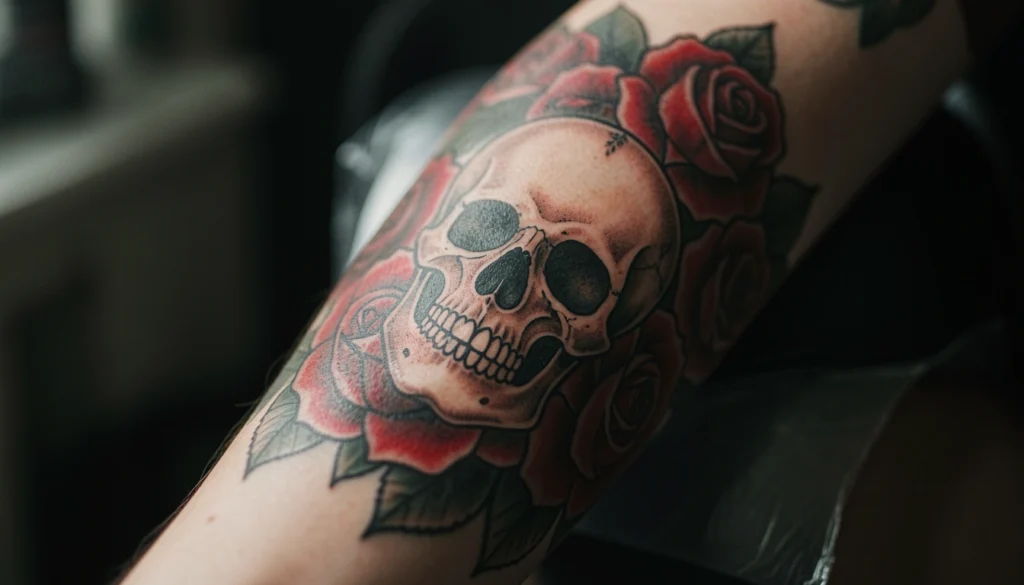
Choosing heavy black outlines and simplified shading will keep a traditional skull tattoo design readable as it heals and with age, because clarity is the core of this style. The skull motif relies on bold contrast and clear negatives to stand out, so deciding on line weight matters before your appointment.
Scale and placement change how much ornamentation you can include, such as crowns, roses, laurel, or flames around the skull. Smaller placements such as the wrist or ankle need fewer interior details, while sleeves or the back can handle more layered symbols without losing readability.
The ideas below compare classic motifs and compositional choices so you can pick a direction and prepare specific questions for your artist. Use these notes to decide placement, color versus black and white, and which small details to keep or remove for better longevity.
21 traditional skull tattoo design ideas to consider
Old school multi symbol
This pin reads like a compact flash sheet with several classic elements arranged around a skull. For a tattoo, choose one dominant motif and use the rest as supportive iconography so the composition does not become crowded. Ask your artist to show how each symbol scales, and request a simplified line study for smaller placements.
Skull with laurel wreath
A laurel around a skull gives a stately, almost victorian medal look, especially on a leg placement where there is room for vertical flow. In black and white this motif reads clearly, but adding a touch of muted green or gold can modernize it without losing the traditional feel. Consider how the curve of the laurel follows the limb to ensure the wreath looks intentional when the body moves.
Triple skull flame row
Three skulls aligned with flames create rhythm across a broad canvas such as the upper back. Repeating the skull motif lets an artist vary expression and shading to avoid monotony, while the flames unify the group. If you want depth, ask for staggered sizes and heavier black in the background so each skull keeps its silhouette.
Black and white flaming skull
A black and white skull with flames emphasizes texture and contrast instead of color. This works well on forearms and chests where viewers see the piece at a medium distance. Discuss how much negative space the flames should have so the image does not blend into surrounding tattoos or clothing shadows.
Skull with crown
A crown adds a narrative touch, suggesting authority, defiance, or irony. For a traditional skull tattoo design, make the crown simple with blocky points and limited jewels so it does not compete with the skull lines. Placement over the chest or shoulder lets the crown sit naturally above the forehead without compressing the crown details.
Skull with rose and swords
Combining a rose and crossed swords in front of a skull balances themes of life and conflict, which is common in traditional designs. Keep the swords linear and the rose stylized so they frame the skull instead of obscuring it. If you plan color, red for the rose and muted metal tones for the swords will read well against bold black outlines.
Cowboy hat skull
A skull wearing a cowboy hat leans into character and cultural references without needing photorealism. This motif works nicely on upper arms and calves where the brim can curve with the limb. Clarify the hat style you prefer because a wide brim or a slouched crown changes the tattoo silhouette and how it reads from a distance.
Foot placement close up
Foot tattoos face more wear and fading because of shoe rubbing and sun exposure, so a traditional skull there should favor bold lines and limited fine detail. If you want ornamentation, keep it small and shallow to avoid blurring as the skin regenerates. Ask the artist about touch up frequency and how the design might settle on the foot over time.
Textured art doll skull
A stylized skull with thread or puppet elements has a narrative quality that suits a forearm or inner bicep, where viewers can inspect details up close. Keep linework confident and avoid overly thin crosshatching because movement can blur tiny strokes. Discuss whether you want the thread lines to remain purely black or to be toned with a muted color for contrast.
Keyhole peek skeleton
A composition that frames a skull peeking through a keyhole creates a strong focal point and plays with negative space. This idea works well as a chest centerpiece or a thigh insert where the keyhole becomes the design border. Make sure the interior details around the skull remain bold enough so the face does not disappear against the dark keyhole edge.
Floral skull with arrow
Flowers with an arrow introduce directional movement to the composition, leading the eye along the arrow shaft. For a traditional skull tattoo design keep the flowers simplified and the arrow straight and bold. Consider whether the arrow cuts through the skull or rests behind it because that choice changes the story and requires different layering techniques.
Bull skull with horns
A bull skull is a strong southwestern motif and reads well at larger sizes due to its horn span. Horns can be decorated with rope or small symbols but avoid excessive filigree which may soften the rugged silhouette. For placement choose an area that can accommodate the horns without wrapping them awkwardly around joints.
Colorful skull crew
A group of skulls in different colors creates playful variety but demands careful palette planning so the piece remains cohesive. Traditional color palettes favor red, green, yellow, and black; keeping those tones consistent will help the cluster read as a unit. If you want each skull to tell a different story, use hats or small props to distinguish them rather than too many color shifts.
Forehead rose skull
A rose on the forehead of a skull places organic life directly in the skeletal negative space which creates a symbolic contrast. In a traditional approach keep the rose stylized with solid fills and classic petals so it reads from a distance. Discuss whether you want the rose centered or slightly off axis; a small shift can change the expression of the whole piece.
Mustachioed skull with hat
Adding facial hair to a skull introduces humor and personality, and a hat further localizes the concept. These elements are best on mid sized placements such as the upper arm where the mustache and hat can be detailed. Make sure the mustache strokes are bold and spaced so they do not merge during healing.
Simple ink skull sketch
A black ink sketch on paper shows how a minimal traditional skull can be effective with economy of line. For tattoos, request a refined stencil that preserves the sketch quality while strengthening crucial outline areas. Minimal designs are often more forgiving on smaller placements and for first time commitment to a skull motif.
Helmed skull with flames
A helmeted skull with flame accents leans into biker imagery and benefits from solid black areas for the helmet and bright flame accents. This concept reads well on shoulders and calves that allow the helmet curve to follow the muscle. If color is important, choose a single flame accent color to keep the design classic rather than cluttered.
Crescent and rose skull
A crescent moon paired with a rose over a skull adds subtle symbolism and a decorative balance. The moon can sit above or behind the skull depending on whether you want a halo effect or a background element. When mapping this composition, ensure the crescent curve complements the skull cranium so the whole piece remains harmonious.
Skull and crossbones sticker
A sticker style skull and crossbones suggests bold flat color and thick outlines that translate cleanly to skin. This motif is ideal for a small, high contrast tattoo such as on the wrist or ankle. Confirm with your artist how wide the outlines need to be to survive touch ups and normal fading over the years.
Skeleton with umbrella scene
A narrative scene with a skeleton holding an umbrella works best as a mid to large piece because it includes negative space and scene depth. For a traditional take keep figure lines stylized and avoid tiny background details that will not age well. Discuss how much of the background should be shaded to prevent the icon from getting lost against other nearby tattoos.
Classic skull and crossbones
A classic skull and crossbones on a shoulder or bicep is a compact expression of the motif and benefits from robust outlines and simple shading. For longevity keep interior stippling to a minimum and favor single block fills of black where depth is needed. If you want movement in the design, add a banner or small ribbon with text that follows the skull curve.
How to plan a traditional skull tattoo design that lasts and reads well
When planning a traditional skull tattoo design prioritize silhouette and bold outlines because clear shapes read longer than fine detail. Decide early whether color is essential; classic palettes use limited, saturated tones, which age differently than large black fills. Consider where the tattoo will sit on your body since high friction or frequent sun exposure affects how quickly lines soften and colors fade. Communicate with your artist about line thickness, which areas should be saturated black, and which small details you are willing to simplify for durability.
Another important step is to request a stencil trial and a scaled mock up of the design on your chosen placement. See how the skull aligns with anatomical features like bones and muscle so the composition moves naturally with the body. If you are combining motifs for a larger piece, ask your artist to provide several layout options that preserve negative space and a clear focal point. Finally plan a realistic touch up window and follow the aftercare your artist recommends to maximize the crispness of this style.
Frequently Asked Questions
A medium size that spans roughly three to five inches across usually works best on the forearm because it gives room for bold outlines and some interior shading without requiring tiny details. Smaller skulls risk losing interior linework as the skin moves and ages, while very large pieces can overpower the limb unless they are balanced with surrounding imagery. Discuss with your artist how the skull will align with the forearm length and which elements are essential so they can plan line thickness and black fills accordingly.
You can definitely use color with a traditional skull tattoo design, but color choices should be intentional and limited to maintain the classic look. Traditional palettes favor saturated reds, greens, yellows and blues paired with strong black outlines; too many colors can make the piece feel busy and complicate future touch ups. If longevity is a concern choose one or two accent colors, request solid fills instead of soft gradients, and ask how the pigments age so you can plan touch ups.
Keep skull features simplified so that teeth and cheekbone contours remain legible over time; concentrated fine lines often blur as the skin changes. Emphasize key contrasts with heavier outlines around the eye sockets, nasal cavity and jaw while using restrained interior shading to suggest depth. If you desire more realism, allocate more surface area so those details can be executed at a scale that will age better, and ask your artist for a strong stencil and bold line plan to preserve definition.
Larger surfaces such as the upper back, chest, thigh, and full sleeves are most suitable for elaborate traditional skull designs because they allow for supporting motifs like crowns, roses and swords without crowding. These placements give the artist room to create strong silhouettes and layered elements while maintaining negative space so each part remains distinct. For detailed scenes request mock ups in different orientations to ensure the composition follows natural body lines and does not warp when you move.
Bring the reference to your consultation and explain which parts you want to keep and which you want changed; good artists will suggest simplifications and compositional tweaks to suit skin and placement. Ask for variations that vary line weight, scale of the skull relative to supporting symbols, and simplified shading to match the traditional aesthetic. Also request a custom stencil so the adapted design fits your anatomy, and discuss color options or black and white treatments to make the piece uniquely yours while keeping the core reference influence.
Ask how they will prioritize silhouette so the skull remains the focal point and how they will space supporting motifs like roses, banners or helmets. Request to see similar work for scale handling and color choices, and discuss potential simplifications to avoid crowded elements. Also ask about expected healing and touch up needs for fine areas, recommended line thickness for longevity, and whether a trial stencil can be placed on your body so you can evaluate the composition before inking begins.
Traditional skull tattoo designs can require fewer touch ups if executed with strong outlines and solid black fills because those elements age predictably, but areas with thin detail or bright color accents may need attention sooner. Factors that affect touch up frequency include placement, sun exposure, skin movement, and how closely the artist placed fine lines. To minimize maintenance, plan for bold, simplified shading, limit fragile tiny strokes, and follow aftercare guidance to protect the piece in the first months.
Traditional skull tattoo design choices come down to three practical filters: silhouette, scale, and the degree of ornamentation you want. Narrow options by marking which motifs you must have and which you can simplify, then pick two to four reference images that show those elements clearly. Save those favorites and note what you like about each so your artist can combine the strongest parts into a coherent design. The most useful takeaway is that clarity matters more than complexity in this style, so prioritize bold lines and readable shapes when you move forward.