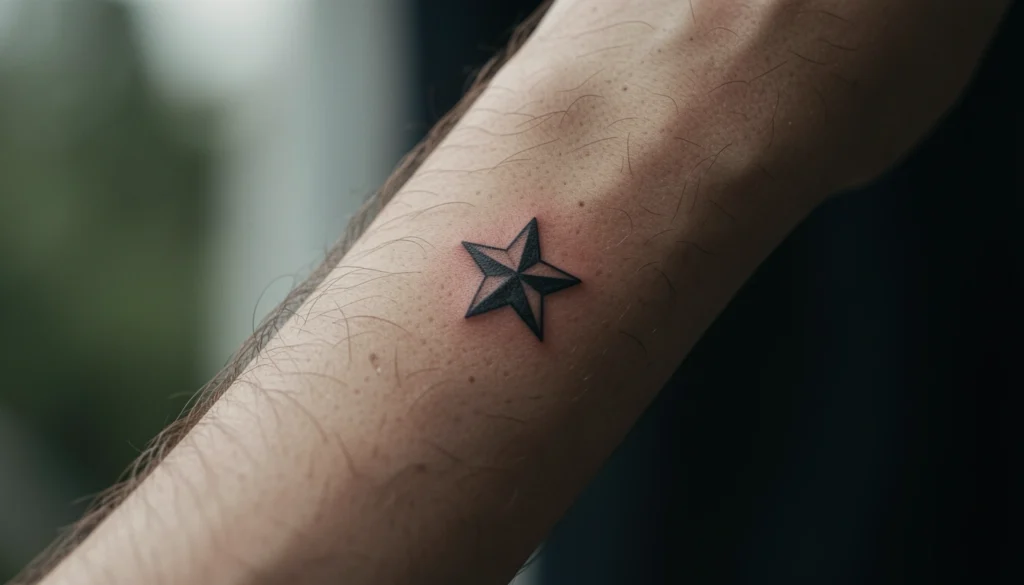
A minimal outlined five point star reads clearly at small sizes, which is why many men choose that approach for small star tattoos for men when they want a discreet motif that still holds crisp line work. Size and line weight matter because stars collapse into blotches if lines are too thin or points are too close together.
Consider whether you want a single star, a cluster, or a star paired with another symbol, because each choice changes how much detail will survive over time and where the piece looks best. Placement such as the wrist, neck, ribcage, or hand affects visibility and how often the tattoo will see sunlight which can change how you plan shading and contrast.
The ideas below show a range of shapes, placements, and pairings so you can compare how scale and composition change the look. Use them to decide whether you want a simple outline, solid black star, or a tiny group that reads as a motif rather than a single icon.
13 small star tattoo ideas for men
Wrist cluster of stars
The image shows a small star on the wrist with three smaller stars trailing behind it, a classic cluster layout that works well when you want a sense of movement or rhythm. For a wrist piece think about spacing so the smaller stars do not blur into the main star as skin settles. Ask your artist for slightly thicker line weight at a tiny scale and consider placing the cluster where the wrist fold will not compress the design while healing.
Simple black line star
A clean black and white star drawing emphasizes geometry and symmetry without shading or fill, so it is easier to maintain crisp edges at a small size. When choosing a line only design confirm the line thickness with the artist because very thin lines can spread over years. This type of star works well on fingers, behind the ear, or on the inner forearm where it can remain discreet yet legible.
Hand and icon pairing
The hand photo shows a small star integrated with other hand tattoos, which highlights how a single star can sit among existing work without overpowering it. If you plan to add stars to a hand that already has tattoos match the line quality and black density so the new piece blends. Hands are high wear areas so expect more frequent touch ups; discuss ink saturation and placement to avoid areas that rub against clothing constantly.
Side of the leg star
A small star on the right side of the leg reads more like a private accent when covered by shorts or pants. This placement gives you room to scale the star slightly larger than a finger tattoo without losing subtlety. Talk with the artist about curvature of the leg because even modest muscle movement changes how a tiny symmetric shape sits; slight adjustments to the point angles can keep the star looking centered when the leg moves.
Delicate arm star
A small star on the outer arm is low maintenance and visible enough to be noticed without dominating a sleeve. Consider whether you prefer a filled black star or an outline because a filled version hides small imperfections but can feel heavier visually. If you want a lighter look ask for a soft dot work texture or tiny negative space at the center so the piece has breath and contrast.
Scattered flying stars
Stars arranged as if flying create a casual, organic composition that suits forearm wraps or chest transitions. The arrangement in the pin includes one star rotated on its side, which demonstrates how varying orientation adds motion. When planning scattered stars map the spacing so the cluster does not look random up close; bring reference photos and ask the artist to sketch the negative spaces as well as the stars themselves.
Single sky star photo reference
A black and white star captured against the sky suggests a more symbolic approach rather than strict geometry, good for men who want an icon with a slightly organic edge. Translating a photographic star into a tattoo often requires simplifying shapes to clean line work or selective shading. If you prefer a softer edge, ask for faint shading around the points to keep the star readable without hard outlines.
Neck star paired with moon
A small star near the neck paired with a moon creates an immediate celestial pairing that fits well on the side of the neck. Neck skin behaves differently from arm skin so discuss the curvature and how the piece will appear under collars or hair. Because the neck is a prominent spot, confirm your comfort with visibility and ask the artist about potential touch ups and how the sun will affect contrast over time.
Star in landscape photo
The photo style here frames the star as a small element within a larger sky, which can inspire tiny tattoos meant to be subtle reminders rather than bold statements. For a small motif inspired by photographic composition consider leaving negative space around the star so it reads as an isolated point. This approach works well near the collarbone or inner wrist where negative space can be preserved naturally.
Arm accent star
A small star on the arm can function as an accent that complements a larger sleeve or stands alone for minimalism. Placement closer to the inner elbow or outer forearm changes how often others see it and how much it moves with muscle flex. If you plan to add more icons later, ask the artist to align the star so future additions feel intentional rather than placed at random.
Ribcage trio of stars
Three stars on the left side ribcage create a neat arc that suits someone wanting concealed but personal work. Ribs are a sensitive area and the skin there moves a lot during breathing so small details can stretch while healing. Choose slightly bolder points and plan the curve with the artist so the trio sits naturally with the rib line and does not distort when you change posture.
Subtle arm accent on a woman model
Although shown on an arm with a feminine presentation, the tiny star translates directly to men’s work as a neutral accent. The pin reminds us that size and contrast matter more than gendered placement. If you want a delicate look but are concerned about fading, plan for a slightly higher black density and book a touch up conversation at the end of the healing period.
Compass and star pairing
A compass drawing with a small star nearby suggests an orientation motif that works well for men who want meaning tied to travel or direction. When pairing a tiny star with a detailed icon like a compass, simplify the star so it complements rather than competes. Discuss scale carefully so the compass retains its fine points while the star remains legible as a discrete element.
Practical guidance for planning a small star tattoo
Deciding on a small star tattoo involves three linked choices: the exact star shape, the line weight or fill, and the placement. A five point outline needs slightly thicker lines than an outline circle would because sharp points can become soft with time. Ask your artist to test a few line weights on the skin as a stencil; what looks right on paper may become too fragile on skin that moves a lot. For a filled black star you can go a touch smaller without the same risk of loss of detail, but a filled piece will age differently than a thin outline.
Think about how often you will expose the area to sun and abrasion because those factors change both initial contrast and long term maintenance. High friction areas such as the hands and ribs require more frequent review and possible touch ups. Before booking, request a placement mock up and a healed photograph example from the artist for a comparable size. That gives you realistic expectations about how the star will sit on your body and what to ask for at the consultation.
Frequently Asked Questions
A star can be quite small and still look crisp if the artist adjusts line weight and point spacing, but there is a practical limit around the size of a dime for detailed point work. Very tiny stars the size of a pea may read as a dot unless the points are kept broad and the lines slightly thicker. To decide, ask the artist to place a stencil so you can see how the shape reads at the exact scale on your skin and choose a line weight that will hold up as the tattoo settles.
Good placements for small star tattoos for men include the inner wrist, outer forearm, side of the neck, behind the ear, and near the collarbone because these areas allow a small design to remain readable while avoiding heavy abrasion. The ribcage and upper arm also work but consider movement and clothing friction, which can affect healing and long term clarity. For a concealed piece choose the ribcage or upper thigh, and for a visible accent choose the wrist or neck after confirming how it will show with your usual clothing.
Whether to fill a small star with black or leave it as an outline depends on the look you want and the expected longevity; filled stars hide small imperfections and stay readable at tiny sizes, while outlines feel lighter but require stronger line weight to avoid blur over time. If you prefer a minimal feel but are worried about spreading, ask the artist for a medium weight outline with a tiny center gap or dot shading to keep the shape clear. Discuss how the piece will be touched up; outlines often need refresh earlier than filled work.
Yes, you can combine small star tattoos with other motifs, but the key is planning negative space so each element breathes and does not merge visually as the skin ages. For example, pairing a tiny star with a moon or compass works if the artist balances sizes and uses consistent line quality. When adding multiple small pieces, create a sketch of the overall composition to see how distances between elements will read up close and after years of slight spread; this helps keep the combined work legible and intentional.
To adapt a reference photo for a very small star tattoo, simplify the shape to its essential lines or silhouette and eliminate tiny texture that will not translate to skin. Turn complex highlights and gradation into either clean line work or a small area of black fill so the design reads clearly from close up and across time. Bring the photo to your artist and ask them to show a few simplified options at the exact scale, then try a stencil on your skin to check how it sits with natural contours and movement before committing.
When booking a small detailed star tattoo ask the artist about their experience with fine line work at tiny scales, request healed photos of similar size pieces, and discuss recommended line weight and ink saturation for longevity. Ask how they plan for placement on moving areas, which areas they avoid for tiny points, and whether they include a touch up option, because tiny work can blur or lighten more quickly. Also confirm aftercare instructions specific to the placement you choose so you can support the piece during healing.
Caring for a small star tattoo follows the same core steps as other tattoos, but because of the small scale avoid over cleaning which can remove too much ink from fine lines. Keep the area gently washed with mild soap, pat dry, and apply a thin layer of recommended ointment or lotion, avoiding heavy creams that trap moisture. Protect the tattoo from direct sun and from tight clothing or equipment that rubs the area until it is fully healed, and follow up with your artist if you notice patchy fading so a touch up can be planned.
Small star tattoos for men succeed when you narrow choices by scale, line weight, and placement rather than chasing a specific angle or orientation. Save a short list of three to five favorites and note what you like about each example, such as the way the points are spaced, the density of the black, or how it sits on the wrist versus the ribcage. Bring those favorites to an artist and ask for a placement stencil so you can see the final size on your skin before inking; that single step usually clarifies the best direction.