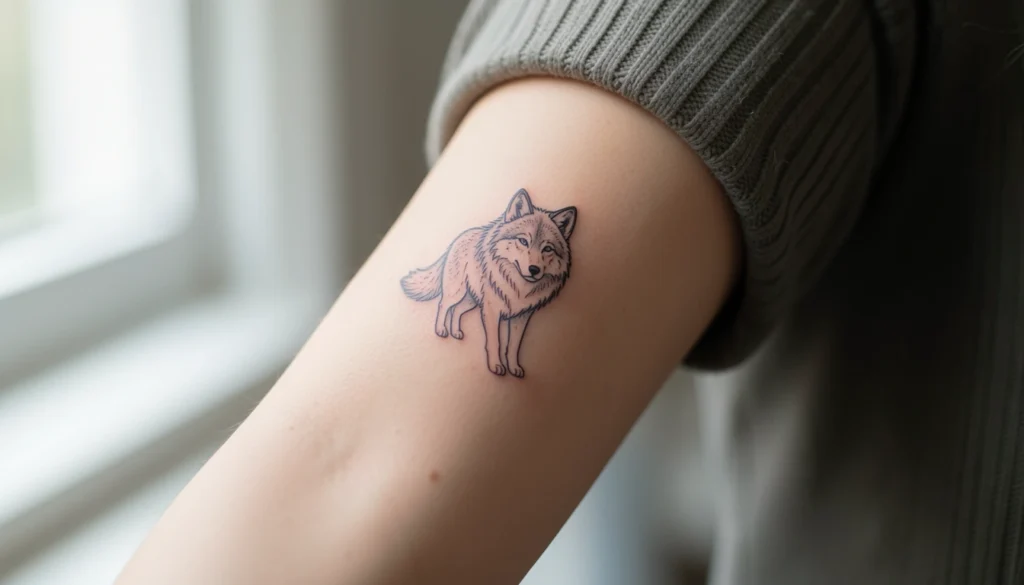
A compact shape and spare linework are what make a minimalist wolf tattoo for women readable at small sizes and suited to subtle placements. Choosing how much negative space to leave around the wolf matters because thin lines can blur if the composition is too tight.
Scale, placement, and whether to use solid black, single line, or light shading are the main decisions that change how the design reads on skin. A tiny standing wolf needs a different level of detail than a larger, semi realistic head piece and that affects both artist choice and aftercare.
The ideas below show different minimalist approaches from single line profiles to small black silhouettes so you can compare scale, readabiity, and how each idea adapts to common placements for women. They will help you pick three favorites to bring to a tattoo consultation.
23 minimalist wolf tattoo ideas for women
Small stomach dog silhouette
This pin shows a small black dog style silhouette placed on the stomach which reads a lot like a compact animal motif rather than a detailed wolf head. For a minimalist wolf tattoo for women, silhouettes are a practical option because they keep the lines bold and easy to maintain. Consider whether you want the shape simplified into one block of ink or outlined to preserve more internal negative space.
Line standing wolf profile
This single line drawing of a wolf looking up emphasizes posture and contour rather than texture, which suits a wrist, forearm, or behind the ear placement. A standing profile like this relies on confident, uninterrupted lines so ask a tattoo artist known for fine line work. If you want it slightly larger, the artist can add minimal shading rather than extra line density to preserve the minimalist feel.
Woman and wolf composition
This piece pairs a female figure and a wolf in an illustrative composition that keeps contrast high while limiting detail. For women who prefer narrative or symbolic images, combining a stylized human with a wolf can remain minimalist if the artist simplifies faces and uses negative space. Discuss with your artist which elements you want to emphasize so the final size does not require extra texture that would break the minimalist intent.
Thigh wolf in black and white
A black and white wolf on the thigh allows a bit more room for subtle fur suggestions while keeping an overall pared back look. The thigh is forgiving for a moderate scale so you can preserve thin line details without risking early blurring. If you like this placement, ask how lines should be spaced to age well on the thicker skin of the upper leg.
Running dog silhouette
The running dog image translates to a minimalist wolf design when simplified into body posture and a flowing tail line. Movement based tattoos read well on limbs and ribs because they follow the body lines, so think about whether you want the wolf oriented along the calf or across the side of the ribcage. Orientation affects visibility and how the motion feels when you move.
Upside down portrait figure
An upside down woman’s head with raised hands is a stylized motif that shows how human elements can integrate with animal shapes for a minimalist sleeve or back piece. For a wolf themed design, consider using the human form as negative space that suggests a wolf silhouette rather than adding extra lines. That approach keeps the look simple while remaining conceptually rich.
Forearm wolf tattoo example
This arm tattoo places a wolf along the outer forearm where elongated designs have room to breathe. Forearm placement suits slightly longer compositions, like a narrow head with a trailing line for the neck. If you prefer subtlety, ask for single needle outlining rather than heavy shading so the design reads as minimal from a short distance.
Wolf with star accents
A wolf drawing with small stars on the back adds a tiny decorative element that keeps the main motif simple. Small star or dot clusters can act as accents without creating extra texture in the wolf itself. Request that any decorative marks remain proportionally tiny so they do not overwhelm the minimalist lines of the wolf when scaled down.
Wolf crowned with flowers
A floral crown on a wolf head blends feminine motifs with animal imagery while staying minimal if the flowers are rendered as line work only. This approach works well for neck, shoulder, or inner arm placements where curves complement the floral shapes. If you prefer a cleaner look, ask the artist to simplify the petals into a few iconic shapes rather than detailed botanical shading.
Small fox on the foot
A small fox on the side of the foot shows how canid designs translate into compact placements; the same sizing principles apply to tiny wolf motifs. Foot tattoos demand careful line thickness because skin and wear differ from other locations. If you want a minimalist wolf here, pick a simple outline with modest negative space and be prepared for potential touch ups down the road.
Line fox drawing reference
Single line drawings of foxes make useful reference sketches for a minimalist wolf tattoo that favors contour over texture. Use this kind of line exploration to decide how continuous you want the outline to be. Bringing a few variations to your consultation helps an artist know if you want separate strokes for snout, ear, and tail or a continuous flow that hints at the whole animal.
Wolf and moon arm piece
A wolf combined with a moon on the arm creates a classic pairing while staying minimal when the elements are simplified into clean shapes. The key decision is whether to depict the wolf realistically or as a graphic silhouette. If you lean toward graphic, the moon can be solid or outlined; either way, keep contrast high to preserve clarity from a distance.
Simple single line fox
A single line fox shows how one continuous stroke can define head, body, and tail while keeping the design minimalist. For a wolf adaptation, the line can be slightly heavier in areas where you want emphasis, such as the jawline. This style suits behind the ear, wrist, or collar bone since the technique relies on precision more than size.
Monochrome wolf head
A black and white drawing of a wolf head reduces detail to shapes and contrast, a strategy that helps the design age more predictably than thin, textured fur. For women who want a minimal but bold chest or shoulder piece, this approach balances presence and restraint. Ask an artist how much negative space they would keep inside the head to prevent a muddy look over time.
Fox shoulder placement
A small fox on the shoulder illustrates how canid shapes sit gracefully on rounded anatomy. Translating that to a minimalist wolf, consider aligning the wolf head to follow the shoulder curve so the design reads well when you are standing. The shoulder also gives you room to expand later if you decide to add subtle botanical curves or geometric framing.
Two women with wolf backs
A drawing of two women with wolves on their backs suggests paired motifs or mirrored pieces for friends who want matching minimalist tattoos. For solo work, the concept can be adapted into a single small wolf with figural negative space. If you consider a mirrored pair, plan placements that align when standing side by side so the images relate visually.
Stylized woman portrait
A black and white woman portrait with hands behind her back shows how minimal portrait elements can pair with a wolf silhouette to suggest a story. If you want a wolf motif kept minimal, use the portrait as supporting negative space rather than adding hair texture or facial detail. This treatment works well on the upper arm or scapula where there is room for respectful scale.
Wolf with leaves on thigh
A wolf plus leaves on the thigh blends natural elements while staying minimal if the botanical parts are reduced to outlines. Thigh placement allows slightly larger scale so you can include simple leaf shapes without crowding the wolf. Discuss leaf size and spacing with your artist to maintain legibility over time and avoid making the composition look busy.
Small lower leg wolf
A small wolf on the lower leg shows how compact motifs can sit on narrower anatomy without requiring extra detail. For minimalist work, prioritize line clarity and ask for proof stencils before inking. Lower leg skin handles simple lines well but be prepared for touch ups if the original lines are extremely fine.
Neck back placement idea
A back of neck design can be small and discreet; a minimalist wolf placed here reads as a personal accent that can be hidden by hair or revealed with an updo. Because the neck moves a lot, keep the lines steady and avoid ultra fine detail that could diffuse during healing. Choose an experienced artist for neck pieces because placement requires careful stencil alignment.
Composite animal wolf design
A wolf designed to include other animal shapes is a creative way to layer meaning while keeping each element minimal. For women who like symbolic layers, ask how the artist will separate shapes with negative space so the wolf remains readable. This format works best when scaled slightly larger so that each internal motif keeps its individual identity.
Small inner arm wolf
An inner arm placement for a small wolf in black ink keeps the motif personal and easy to conceal. The inner arm tolerates fine lines moderately well but the artist will likely suggest slightly heavier lines than the thinnest single needle to avoid early feathering. Think about whether you want the wolf facing toward or away from your body; orientation changes how it reads in photographs.
People forming wolf shape
A line drawing of two figures creating a wolf head is a conceptual way to make a wolf motif without depicting fur or anatomy. Such negative space tricks are excellent for a minimalist tattoo because they let the viewer fill in the shape mentally. If you like conceptual designs, bring several references so your artist can sketch how the figures combine into a cohesive wolf silhouette.
How to choose size, placement, and line style for a minimalist wolf
Deciding between a tiny, discreet wolf and a slightly larger statement piece depends on where you want the tattoo and how much time you want to spend on touch ups. Smaller pieces are best when composed of bold, simple shapes rather than fragile textures because thin parallel lines can blur over time. Pick placements with relatively stable skin such as the outer forearm, thigh, or upper shoulder if you want any small details to remain clear, and expect that areas with more movement or friction like the lower leg or side of the foot may require more frequent maintenance.
Line style matters as much as placement. Single line or continuous stroke designs create a minimalist aesthetic but demand an artist with steady, precise technique. If you prefer some depth without leaving minimalism, ask for restrained dot work or sparse shading in key areas such as the muzzle or eye rather than dense texture across the whole piece. Before you commit, request stencils and scaled mockups so you can see how the design reads at the exact size you want; this gives you a clear view of whether details survive the reduction and how the composition will sit on your anatomy.
Frequently Asked Questions
A minimalist wolf can be as small as one to two inches across and still remain legible when it is designed with bold, simple shapes and adequate spacing between lines. Extremely thin single line work at very small sizes risks early blurring because the pigment spreads over time. To improve longevity, ask your artist to slightly thicken the main outline and to avoid tiny internal details that depend on high resolution. Placement also affects clarity, so choose areas with stable skin and lower friction rather than the side of the foot or parts of the hand. Finally, get a stencil at your chosen size and evaluate it in natural light to confirm the look before inking.
Common placements that suit a minimalist wolf include the outer forearm, inner arm, thigh, upper shoulder, back of the neck, and lower rib area because these locations give enough room for the design without extreme distortion. The outer forearm and thigh are forgiving for small to medium scales while the back of the neck or behind the ear are good for very compact motifs. Avoid places subject to constant rubbing or stretching if you want the lines to age cleanly. Always request a template from your artist so you can test how the shape sits with your natural contours and movement.
Choosing between single line and filled black shapes depends on your aesthetic and how small the tattoo will be. Single line designs feel delicate and artful but require a very steady hand from the artist and slightly more space to preserve clarity. Solid black silhouettes are more forgiving over time because they age into a recognizable shape even if minor spreading occurs. If you like both, consider a hybrid where the main silhouette is solid and the interior contains minimal line accents or small negative space to suggest features.
Yes, you can combine floral or celestial accents with a minimalist wolf while preserving simplicity by keeping added elements small and stylized rather than detailed. For example, a few outline leaves, a tiny crescent moon, or scattered dots for stars can enhance meaning without cluttering the main motif. Place accents at the edges of the wolf to frame the composition rather than inside the wolf where they could interfere with legibility. Discuss scale and spacing with your artist to ensure the decorations remain proportionate and optional in future expansions.
Prepare to ask about the artist’s experience with fine line work and minimalist animal motifs, inquire how they would adapt the design for your chosen placement, and request to see healed examples of similar pieces. Also ask about recommended size for legibility, needle grouping preferences, and expected touch up needs. Bring several reference images that highlight the aspects you like such as posture, single line flow, or floral accents. Finally, request a scaled paper stencil so you can confirm orientation and size on your body before the session.
Aftercare follows the same basic principles as other tattoos but pay attention to friction and moisture which can affect small, fine lines. Keep the area clean and moisturized according to your artist’s instructions, avoid tight clothing that rubs the tattoo while it heals, and protect it from direct sun exposure once healed. Small tattoos on areas like the foot or lower leg may need extra care because shoes and socks can irritate them during healing. If you notice uneven fading or puckering after healing, consult your artist about a touch up rather than trying to fix it on your own.
To adapt a reference photo, ask the artist to simplify the image into essential lines and shapes that follow the curves of your chosen placement. For example, a reference with heavy fur texture can be reduced to a clean outline and a few strategic marks for eye and jaw. Consider the natural flow of the body area and have the artist create several composition options that test orientation and negative space. Discuss whether you want continuity with nearby tattoos or a standalone piece so the final adaptation looks deliberate and wearable on your anatomy.
Choosing a minimalist wolf tattoo for women becomes easier when you focus on three things: size that preserves clarity, a placement that suits the line work, and a single stylistic decision such as continuous line, silhouette, or light shading. Save three references that highlight what you like about scale, posture, and line quality, and note one question for the artist about longevity. Bring those favorites to your consultation so the artist can make a scaled stencil and recommend the exact adjustments for a design that stays readable and meaningful over time.