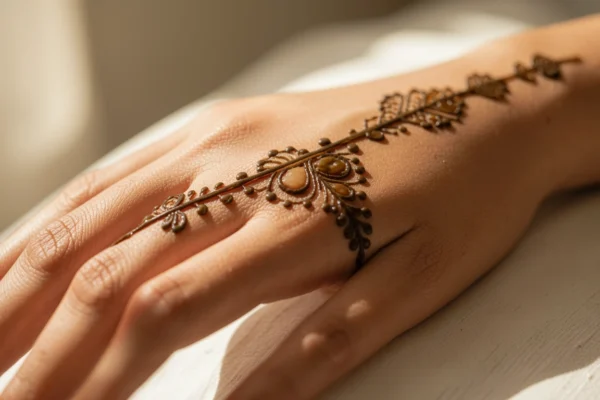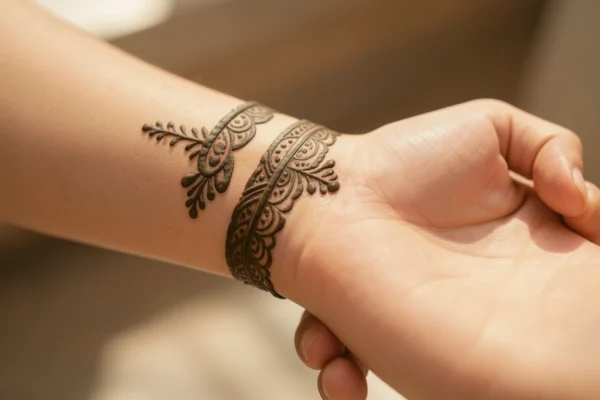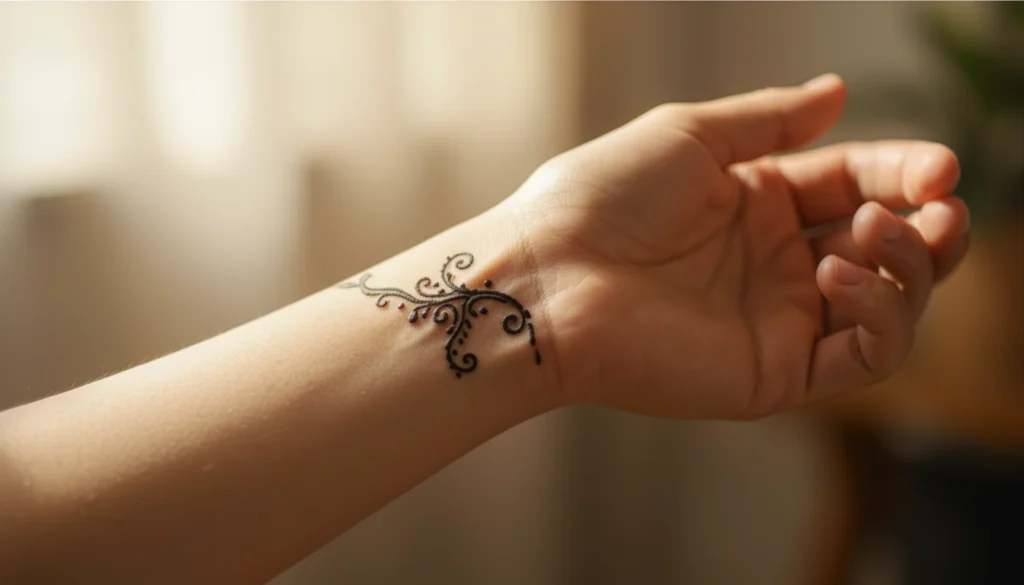
Fine line spacing determines how well a small henna piece will stay crisp on fingers and wrists. If you want minimalist henna tattoo designs simple, choose motifs with clear negative space so the pattern does not blur together as the paste fades.
Scale and placement change what details you can include. A tiny motif on a fingertip needs fewer strokes than a wrist panel, and skin that moves will make very thin lines lose definition more quickly.
The ten pins below show compact motifs, finger bands, and small wrist pieces with notes on placement, scale, and how to describe each idea to an artist. Use these comparisons to pick a direction and prepare questions for your appointment.
10 simple minimalist henna tattoo ideas to consider
Delicate finger symbols
This pin shows a hand with small tattoos on individual fingers and a single central accent on the middle finger. For a henna translation, keep motifs very small and allow skin to breathe between elements so each symbol reads on its own. Ask an artist to show you the scale on your finger before applying paste and to use slightly thicker lines than a tattoo artist might use for permanent ink.
Subtle wrist accent
A small wrist motif sits on the left side of the wrist in this image, which is a useful placement for a simple henna design. The wrist is flat enough to hold slightly more detail than a finger while still being easy to conceal with a sleeve or bracelet. When you ask for a similar piece, mention whether you prefer the motif centered or offset toward the thumb side so the artist can adapt symmetry and flow.
Planetary wrist line
This wrist tattoo features small planets and stars aligned along the arm, which adapts well into a minimalist henna band. Spacing between each element matters so that the tiny circles and dots do not merge as the paste flakes. If you want a sequence like this, decide whether you want even spacing or a focal point such as a larger central planet to anchor the composition.
Matching finger marks
Two hands with finger markings show how matching motifs can read as a set without being identical. For minimalist henna work, match scale and spacing rather than copying every line; that keeps each piece wearable on different finger sizes. Discuss whether you want exact mirror placement or complementary placement so the designs interact when hands are held together.
Stars and moon cluster
Stars and a small crescent appear on the hand with rings in this image, which demonstrates how jewelry and henna style marks can layer visually. When converting to henna, small dots and tiny star shapes are easier to maintain than fine shaded stars. Consider how rings will sit relative to the motif and whether you want the design to peek out from under jewelry or sit between bands.
Casual hand placement
Someone holds their hand to show simple hand marks in this pin, a good reference for a compact palm border or small back of hand motif. The back of hand lets you add a tiny sun, dot line, or leaf without needing a full panel. Ask whether a narrow border or single central mark will better suit your movement and clothing choices.
Small sun motif
A compact sun on the arm makes a clear focal motif and translates cleanly to henna when simplified to line work. Suns can be done as a circle with rays or as a stylized dot surrounded by short lines. Decide on ray length and whether you want solid fill or only outlines so the artist can test a scale that fits your arm.
Single hand accent
This image pairs a small hand tattoo with a domestic scene, highlighting how a tiny motif can feel casual and modern. For henna, a single simple element near the thumb or on the side of the hand can be striking without requiring a full session. Bring the photo and point out the exact spot you prefer so the artist can place it according to your hand shape.
Complementary matching arms
Two people wear matching but distinct arm marks in this pin, with one motif like an eye and the other a fish. Translating this to simple henna means choosing motifs that read independently and as a pair. Talk about scale and whether you want both designs to be the same size so they balance visually when arms are side by side.
Henna and cross wrist mix
A hand with small henna style marks and a cross on the wrist shows how religious or symbolic marks can sit near ornamental elements. If you want meaningful symbols next to decorative motifs, decide which element should be dominant and whether boundaries such as dots or a short line will separate them. Clarify with your artist how to keep the symbols readable at small sizes.
How to decide size placement and line detail for simple designs
Begin by choosing the smallest area where the motif will still be legible. Fingers, the side of the hand, and the outer wrist are common for minimalist henna because they take small motifs well. Think about movement and how skin stretches on knuckles and near joints. Very thin lines can look delicate but may blur as paste flakes, so ask the artist to thicken critical strokes slightly when you want the motif to remain clear for several days.
Next, match detail to distance and function. If you want a piece for special occasions, a slightly denser pattern is acceptable. For everyday wear or work that involves frequent hand washing, prioritize bold simple shapes and leave more negative space. Before your session print a reference image sized to the area you want and bring notes on which details are essential so the artist can create a test layout and adjust scale on the spot.
Frequently Asked Questions
You adapt simple minimalist henna tattoo designs for fingers by scaling motifs to the available space and emphasizing clear negative space. For fingers reduce line complexity to avoid details that will merge when the paste flakes. On the wrist you can allow slightly more detail but still avoid very thin isolated strokes. A good next step is to print the reference image at the exact size you want and ask the artist to draw a pen mockup on your skin so you can confirm scale and placement before any paste is applied.
Line thickness should balance delicacy and durability. For simple henna motifs choose lines that are visible from a short distance without being so thick they lose the minimalist aesthetic. Very thin hairline strokes can look elegant but often break up unevenly as the paste dries and flakes, so aim for slightly bolder lines than you would for a fine tattoo. Discuss cone tip size or application pressure with the artist and consider a test dot and stroke to see how the paste spreads on your skin before committing to a full design.
Yes you can combine minimalist henna elements with a permanent tattoo but plan the relationship between the two pieces. Use henna to accent lines or negative space around an existing tattoo rather than trying to replicate permanent ink detail. Decide whether you want the henna to sit next to the tattoo or to frame it and tell the artist which elements of the permanent piece are most important so they can avoid covering or obscuring them. If you have raised or healed scar tissue near the tattoo explain that to the artist because surface texture can affect how paste adheres and dries.
Describe placement by pointing to the exact spot on your hand or arm and note its relationship to landmarks such as the knuckle the wrist bone or the base of a finger. For size bring a printed reference scaled to the area or trace the printed motif on your skin with a washable marker so the artist can see the exact footprint. Say whether you want the piece centered offset or aligned with a ring and whether it should be visible only during certain movements. Clear visual cues make it easier for an artist to match your expectations.
Motifs with clear outlines such as simple suns moons stars dots and small botanicals translate best into minimalist henna because they rely on line and negative space rather than fine shading. Geometric dots and small circles also read well at tiny scales. Avoid designs that depend on tight shading or tiny internal details because those features are less likely to remain distinct as the paste flakes. When choosing motifs consider how they will look from a short distance and whether each shape can stand alone if parts soften during wear.
The visible life of a simple henna piece varies with skin type placement and daily activity but typically ranges from a few days to about two weeks. Hands and fingers often lose contrast sooner because they are washed more frequently and the top layers of skin renew quickly. To maximize visibility choose slightly bolder lines avoid excessive scrubbing and discuss paste quality and aftercare tips with your artist. If you want a longer lasting look plan for touch ups or refreshes rather than expecting the same contrast as a permanent tattoo.
Testing a design before an event is a practical step especially if you are relying on a very simple motif for a specific look. A trial lets you confirm scale placement and how long the paste remains visible on your skin so you can adjust line thickness or spacing. Book a quick test session at least a week before the event so you can see how the piece develops and make changes. This rehearsal also gives the artist a chance to tune their cone pressure and application speed for the exact result you want.
Minimalist henna tattoo designs simple work best when you choose a couple of clear priorities such as placement and how much negative space you want. Narrow choices by picking three favorites that vary in scale so you can see which size fits your hand or wrist. Save those images and note what you like about each for a clear brief to the artist. A focused selection and a printed size reference will make it easier to get the clean minimalist result you want.