


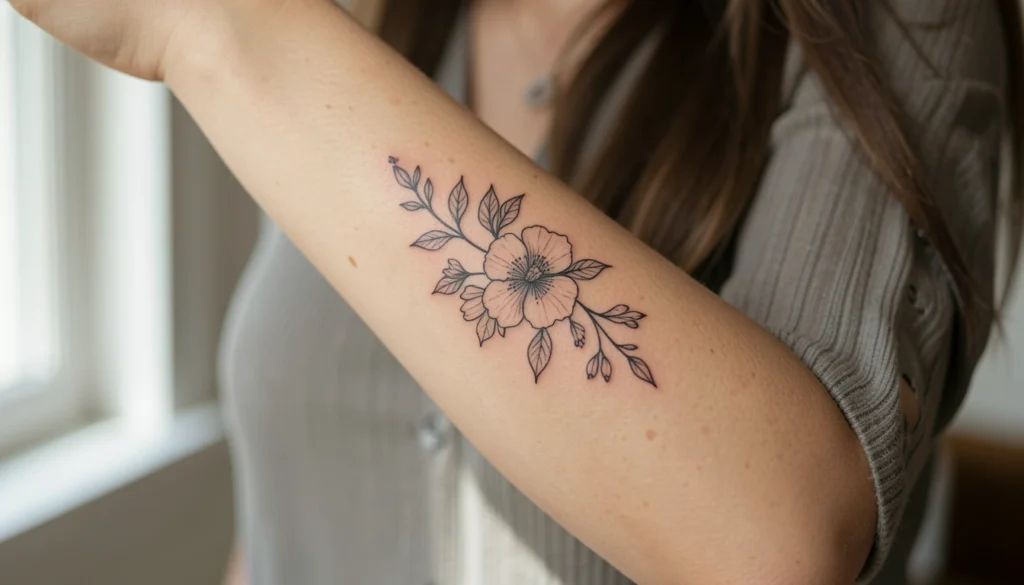
A tiny floral motif near the inner forearm reads clearly even when scaled down, which is why delicate small arm tattoos for women often rely on clean line work and deliberate spacing. Choosing whether to place the design on the inner arm, outer arm, wrist, or near the elbow affects how much detail will hold up over time and how visible the tattoo is in daily life.
Scale matters more than the motif when a tattoo is small; fine lines should be balanced with slightly stronger outlines so the design does not blur as it ages. Consider whether you want a standalone symbol that reads at a glance or a small composition that invites a closer look, because that decision changes needle selection, stencil size, and expected touch up needs.
The ideas below help you compare floral motifs, tiny icons, and single line symbols, and they point out the artist questions that will help you refine size and placement before booking an appointment.
23 delicate small arm tattoo ideas for women
Black and white floral pair
The composition suggested by the pin shows matched florals in black and white that flank an imagined focal point. For small arm tattoos this kind of balanced pair works well on either side of the forearm or near the wrist where symmetry reads clearly. Ask your artist how much inner negative space they would keep between the two florals so each bloom remains distinct at the intended size.
Casual wrist hold pose
The photo emphasizes a discrete left arm mark that sits naturally when the wearer folds their hands. Tattoos that sit close to the wrist should keep strokes simple and avoid tiny details that can blur into a smudge over time. When you bring a reference like this, clarify whether you want the work higher on the forearm or right at the wrist crease so healing and visibility match your preference.
Understated portrait pose
The image frames a small arm motif while the subject rests her hand near her face, suggesting a design meant to be glimpsed rather than announced. Small tattoos that are intended as personal touches do best when inked on the inner forearm or just below the elbow where they are easy to cover. Discuss expected contrast with the artist so the lines read against your skin tone without requiring excessive size.
Single small flower
A solitary flower placed on the left side of the arm reads as a delicate accent and is a natural choice for first time small tattoos. Floral motifs translate well into simplified black line versions that will hold up, but if you want internal shading or dot work be ready to slightly increase the scale. Ask your artist for a stencil placed on the exact location so you can judge the visual balance before ink meets skin.
Minimal wrist gesture
This photo highlights a compact symbol near the lower forearm held by the opposite hand, suggesting an intimate placement. For the wrist and lower arm avoid extremely thin cross hatching or tiny script that will lose clarity; instead choose defined line weights and modest negative space. Consider whether you want the piece visible in sleeved clothing and tell your artist the exact shirt type you wear most often.
Clustered back of arm marks
The pin shows multiple small tattoos on the back of the arm that create a curated feel, useful if you plan to add more later. When clustering small arm tattoos, keep spacing consistent so each element has breathing room; overlapping details can merge as the skin ages. Ask about how future additions would align with the current elements and whether the artist recommends slightly different scales for pieces that will sit side by side.
Flower above the elbow
A flower placed mid arm or just above the elbow reads differently when the arm bends, so consider motion when choosing placement. This area tends to stretch and compress more than the forearm, which affects how thin lines age. Request a mock up or photo with the stencil both extended and flexed so you can see how the design moves with your arm.
Left side arm accent
The small left side arm mark shown is a classic option for someone who wants a single focal point without additional elements. Placement on the outer arm catches light and is slightly more exposed to sun than the inner arm, so plan for diligent sun protection. Discuss with the artist whether to use more contrast in the original session to account for future fading with sun exposure.
Subtle arm silhouette
The image displays a clean small tattoo that sits comfortably along the arm silhouette and reads at a small scale. For designs that follow the curve of the arm, such as small leaves or line shapes, the contouring should be calculated so the piece does not look skewed from multiple angles. Ask your artist to sketch the layout directly on your arm so you can approve the orientation before work begins.
Cross symbol close up
The cross tattoo pictured is compact and suited to the inner forearm or near the wrist where it can be seen by the wearer easily. Small religious or symbolic tattoos benefit from slightly bolder central lines to keep the silhouette crisp over time. If alignment is important, bring reference photos and note whether you prefer vertical centering or a subtle offset toward the thumb side.
Discrete left arm dot mark
The pin suggests a very discreet mark on the left arm that reads as a personal accent more than a statement. Tiny single element designs are low commitment and easy to add around later, but they do require a considered line weight so the central shape remains legible. Confirm with your artist how they will space dots or small marks to avoid crowding when you add more pieces.
Arm and shoulder pairing
This photo shows a small tattoo on the arm paired with a shoulder mark, which creates a visual link across two nearby surfaces. When pairing arm and shoulder tattoos, the scale should be related so one does not overpower the other; smaller arm pieces can nod to a larger shoulder motif with shared line style. Talk to the artist about transition elements that can later connect the two pieces if you plan to expand the collection.
Band accessory wrist placement
The wristband view points to tiny ink placed where a watch or band would sit and suggests a design that complements accessories. If you regularly wear bracelets or a fitness band, test how the tattoo will appear underneath or beside those items to avoid constant rubbing during healing. The artist can advise on placement that avoids tight bands while keeping the design visually integrated with jewelry.
Single bloom statement
A lone flower on the left side of the arm makes a clear, feminine accent and is one of the most adaptable small tattoo ideas. Decide whether you want a minimal outline, light dot shading, or a small amount of tonal fill, because each approach changes how small the motif can be while remaining readable. Ask for a test stencil at the intended scale to see how it sits against the arm curve.
Centered mid arm symbol
The image shows a compact symbol centered on the mid arm, a location that gives the design room without being too exposed. Central placements make symmetry easier to achieve and often suit motifs that look balanced when viewed straight on. If you want the piece to align with anatomical landmarks, ask the artist to position the stencil relative to your elbow or wrist for reproducible placement.
Casual arm portrait
The photo frames a small arm motif as part of a relaxed portrait, implying a tattoo that is personal and low profile. For pieces intended to be intimate rather than bold, prefer simpler silhouettes with clear outlines that can be read at a glance. Planning for modest contrast up front helps avoid a heavy look that can overwhelm when the piece is small.
Wrist floral accent
A small flower near the wrist reads as an elegant accent and is a natural choice for someone who wants a visible yet discreet piece. Because wrist skin is thinner and moves often, choose designs with fewer interior lines and slightly thicker outlines than you might use on the shoulder. Talk to the artist about touch up likelihood and realistic expectations for detail retention at this site.
Low profile left arm mark
This pin shows a modest tattoo that sits low on the arm and reads as an almost hidden accent. Low profile pieces are ideal when you want flexibility to cover them for work or formal events. Discuss exact vertical placement so the tattoo remains concealable under sleeves without being awkwardly tucked under clothing seams.
Soft forearm placement
The design here sits comfortably on the forearm where it is both visible and protected, a practical compromise for many people. Forearm tattoos can be slightly more detailed than wrist tattoos thanks to a wider canvas, but they are more exposed to sun so protection matters. Bring up how you typically expose your forearms to sunlight so the artist can advise on line weight and pigment choice.
Whimsical flying mouse drawing
A small drawing such as a mouse in motion makes for a playful arm accent and translates well into line work or light dot shading. Character based tattoos are most successful when simplified so expressions and motion read at a small scale. Ask your artist to reduce or stylize background detail so the figure remains the focal point at the size you want.
Minimal single mark
The pin highlights a discreet single element that blends into daily wear, a good option for a first tattoo. Minimal marks should be planned for line weight and spacing so they do not fade into an unrecognizable blotch. Confirm with the artist where the piece will sit relative to natural creases to reduce movement during healing.
Simple arm side mark
This composition places a small tattoo on the left side of the arm where it can be both private and visible depending on your sleeve choices. Side placements are comfortable if you want the piece seen only with certain gestures. Ask to see a preview photograph of the stencil from different angles so you can visualize how it will appear in motion.
Cursive lucky with butterflies
The combination of cursive text and small butterflies gives a gentle, narrative quality to a small arm tattoo, but script at small sizes can lose legibility. If you like a word plus tiny motifs, request a slightly larger scale for the script or a bolder script weight to keep characters clear. Also discuss how the butterflies should be spaced so they complement rather than crowd the lettering.
How to plan and prepare for a delicate small arm tattoo
When you are considering delicate small arm tattoos, the practical decisions are mostly about scale, line weight, placement, and future expansion. Small pieces require more careful consideration of line thickness than larger pieces do; extremely fine hair lines can look lovely at first but may soften over several years. Ask your artist to draw the stencil at the exact size you want and to photograph it from multiple angles so you can check readability and alignment with your arm contours before sitting for the work.
Placement affects both healing and visibility. The inner forearm tends to be protected and heals predictably while the wrist and the back of the arm see more friction and sun exposure which can accelerate fading. If you plan to add more small elements later, coordinate scale and spacing now so future pieces will integrate smoothly. Finally, bring specific reference pins to your consultation and be ready to discuss which aspects are essential, which are negotiable, and whether a slight increase in size would improve longevity and clarity.
Frequently Asked Questions
Start by deciding how visible you want the tattoo to be and whether you plan future additions. For delicate small arm tattoos for women a common rule is to avoid ultra fine interior detail at very small sizes because lines can soften with time. Ask your artist to provide a stencil at the exact intended dimensions so you can check legibility, and discuss slight increases in scale if your favorite design includes tiny features. Also consider placement because areas that move a lot or are exposed to sun may need bolder strokes to preserve clarity.
Inner forearm, just above the wrist, and the outer forearm are the most common placements for subtle small tattoos because they offer different balances of visibility and protection. The inner forearm is slightly more sheltered from sun and friction so fine line work often lasts longer there, while the wrist is highly visible but experiences frequent movement and contact which can affect healing and long term clarity. The outer forearm shows well with most clothing and provides a broader canvas for slightly more detailed small pieces. Choose placement based on how often you want the tattoo seen, how much sun exposure the area receives, and whether you plan to expand into a cluster later.
A tiny arm tattoo can hold simple shapes, single words in readable script, and minimal floral or geometric elements if the line work is appropriately scaled. Very small text, densely shaded areas, and ultra fine cross hatching are the most vulnerable to blurring because the ink spreads slightly under the skin over time. If you want detail, consider a modest increase in size or choose a style that uses contrast and negative space rather than small internal strokes. Ask your artist to adapt the reference so key features remain strong while secondary details are simplified or suggested through dots and light shading.
Yes combining motifs later is a common approach and often preferable to committing to a large composition immediately. When planning additions, align scale and line style so new elements read as part of a cohesive set rather than a random collection. Leave intentional spacing around the original piece and discuss transitional elements with your artist that can link pieces visually if you decide to join them over time. Bring both existing tattoos and future idea images to consultations so the artist can advise on placement and proportion for smooth integration.
Customizing a reference pin is usually wise because published images may not have been designed for the exact scale or placement you want. Copying a design exactly can work, but an experienced artist will often recommend slight adjustments in line weight, spacing, or size to ensure the piece holds up on your skin and in the chosen location. Discuss which features of the pin are essential and which can be altered, and ask the artist to show a modified stencil before tattooing. This collaboration helps ensure the final tattoo reads well at the scale you will wear it.
Ask the artist about recommended size and line weight for your chosen motif, whether they have examples of similar small arm work, and how they plan to position the stencil relative to anatomical landmarks. Inquire about expected fading, suggested aftercare for a wrist or forearm placement, and the likelihood of requiring a touch up. Also ask how they would adapt your reference for your skin tone and movement patterns and whether they recommend small changes to improve longevity and clarity. Bring multiple reference images and tell the artist which details matter most so they can guide scale and style choices.
Aftercare for a small arm tattoo follows the same fundamentals as other tattoos but pay attention to the specific challenges of the location. Keep the area clean and moisturized with the product your artist recommends, avoid tight bands or watches that may rub the site during the first two weeks, and protect the fresh tattoo from sun exposure which can accelerate fading. Be mindful of shower temperature and avoid soaking the area, and contact your artist if you see signs of unusual redness, swelling, or prolonged discharge. Planning clothing and accessory choices for the healing period reduces friction and supports a better outcome.
When narrowing choices for delicate small arm tattoos for women focus on three things: the motif scaled for clarity, an arm placement that matches your lifestyle, and an artist who adapts references for longevity. Save a small set of favorites and note what you like about each one for your consultation. Identifying whether you prefer simple outlines, light shading, or tiny symbolic marks makes the artist conversation productive and helps you leave the studio with a piece that still reads beautifully years from now.


